Table of contents
Bleaching always damages hair; the only question is how much. Bleach swells the cuticle and dissolves pigment from inside, breaking bonds that do not grow back. Kept controlled, with four to eight weeks between sessions, the damage stays manageable. Pushed too far in one sitting, it does not.
There is no gentle bleach, only a well-managed one. Anything sold as gentle is either a toner that does not lighten at all or a bleach bath, which is the same chemistry diluted. The process itself never changes.
That is not an argument against it. Millions of people wear bleached hair for years in excellent condition. What decides the outcome is how much is asked of one session and what happens in between. This article covers both without dramatising and without glossing over.
What happens inside the hair
A hair has three layers. On the outside sits the cuticle, overlapping like roof tiles. Underneath is the cortex, holding the melanin pigment in keratin strands linked to each other by bonds. Thick hair also has a medulla in the centre.
Bleach is an alkaline powder plus a developer, which is a hydrogen peroxide solution. The alkali swells the cuticle so the peroxide can reach the cortex, where it breaks melanin into smaller colourless fragments. Those fragments wash out, and the hair is lighter because there is less pigment in it.
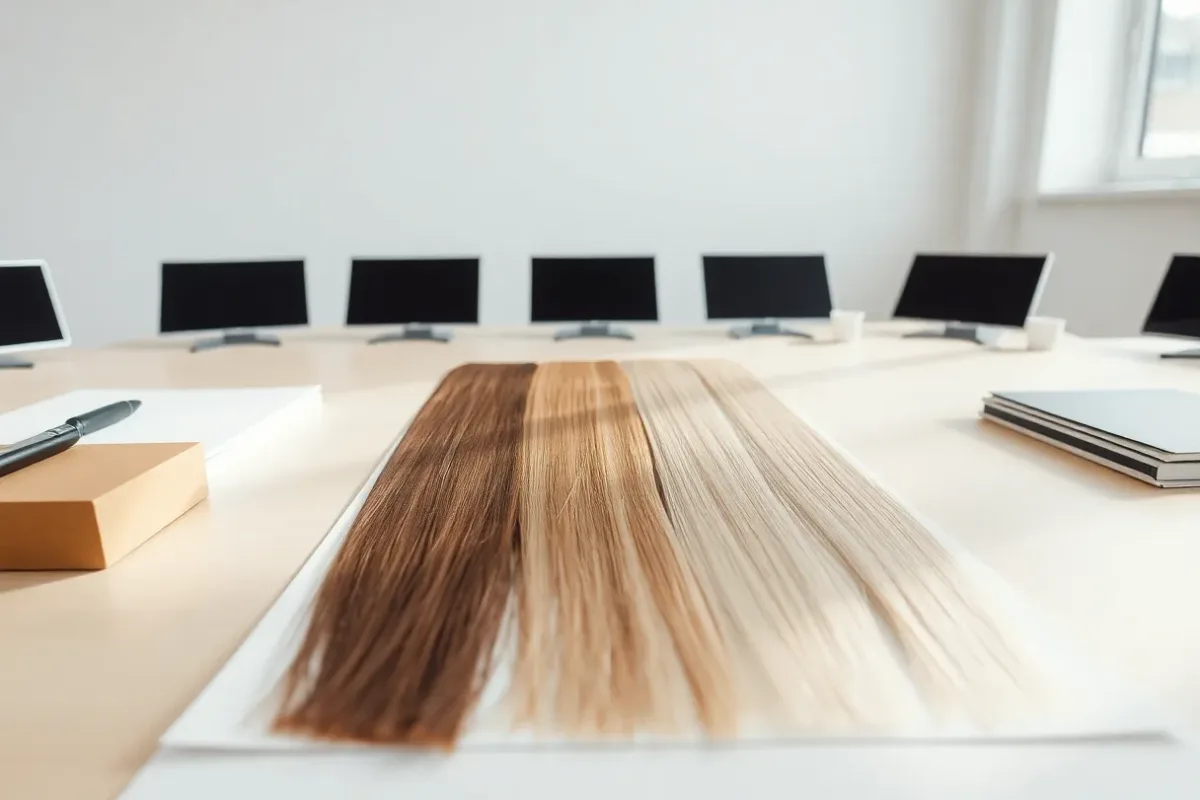
How light depends on where you start. The scale runs from level 1, black, to level 10, the palest blonde. A single session lifts two to four levels depending on developer strength, which is why going from level 3 to level 9 is a route rather than an appointment.
Two side effects are unavoidable. Some of the keratin bonds that give hair its elasticity are damaged along the way. And the cuticle never closes quite as tightly again, so the hair is more porous: it takes on moisture quickly and loses it just as fast. That is precisely why toner rinses out of bleached hair faster than out of virgin hair.
Lightening is not adding something, it is removing something — and what is removed does not come back.
How to spot over-processing
You can assess this at home without equipment. Stretch a single wet hair gently between two fingers. Healthy hair stretches a little and springs back. Over-processed hair stretches a long way, fails to return, or snaps.
Do it wet, because hair is at its most elastic and therefore most informative when wet, and use a hair from your brush rather than one still attached to your head.
| Sign | What it means | What to do now |
|---|---|---|
| Gummy when wet | structure badly compromised | no more lifting, protein treatment |
| Snaps while combing | breakage at weak points | trim, pause hot tools |
| Tone gone in days | high porosity | mask, leave-in, wash less |
| Tangles instantly when dry | cuticle standing open | acidic rinse, less friction |
| Short broken hairs on top | breakage, not new growth | postpone the appointment |
When several of these appear together, the next appointment is a cut rather than a lift. How far up the damage has to be removed is covered in split ends: cut or treat.
The four settings that limit the damage
Developer strength
Developers come at 3 percent (10 vol), 6 percent (20 vol), 9 percent (30 vol) and 12 percent (40 vol). The higher the number, the more levels per session and the more stress. Because the scalp radiates heat, the root often needs a lower strength than the lengths.
Processing time
Bleach is rinsed on sight, not on a timer — the manufacturer's figure is a ceiling, usually no more than 50 minutes. Leaving it on to squeeze out one more level is the single most common mistake in home application.
Spacing between sessions
Four to eight weeks between lifts. Trying to force the whole route from dark to blonde into one sitting produces exactly the damage this article is about.
Bond builders
Bond builders are mixed into the bleach and protect part of the internal bonds during the service. They do not make bleaching harmless, but they measurably reduce breakage, and a good salon reaches for them without being asked on strong lifts.
One caveat on order: a bond builder is not conditioner. It stabilises structure but does not make hair supple. Used alone, without a mask, it leaves hair strong and straw-like.
Related articles
What not to do at home
The three damage patterns that end up on a salon's correction list nearly all start at home: pulling bleach through already bleached lengths, two lifts in one day, and bleach over hair treated with direct dyes or henna.
Overlapping is the classic. Sweeping product from root to tip lightens the lengths a second, third and fourth time. The root goes bright, the lengths go porous, and eventually they break off around shoulder level.
Sequence matters too. Bleach and chemical restructuring never belong on the same day. Why that is particularly critical around chemical relaxing is spelled out there.
About the kitchen-cupboard methods
Lemon juice, chamomile, bicarbonate of soda, honey and drugstore peroxide come up again and again as gentle alternatives. Anything that genuinely lightens does it through the same chemistry as bleach — just without pH control and without the option to rinse at the right moment. Anything that does not lighten simply costs time. Lemon juice in the sun adds dryness, and bicarbonate is strongly alkaline, swelling the cuticle for no colour benefit at all.
The difference in a salon is not the product but the control: assess the level, choose the developer, work in sections, check every few minutes, rinse at the right moment. Those five steps are what is missing at home.
If there is old colour in your hair, a strand test is not optional. A salon can run one in twenty minutes and will know afterwards whether lifting is possible at all. At salons that take online bookings a short consultation slot can usually be booked separately for exactly this.
Aftercare that actually matters
Bleached hair needs two different things in rotation: moisture and protein. Moisture gives suppleness, protein gives structure. Too much protein makes hair brittle, too much moisture makes it limp. A workable rhythm is one moisture mask a week and one protein treatment every three to four weeks.
- Wash lukewarm, rinse cool.
- Squeeze wet hair rather than rubbing it — bleached hair is at its most fragile when wet.
- Wide-tooth comb instead of a brush on wet hair, working from the ends upwards.
- Keep hot tools at 150 to 180 degrees and never use them without heat protection.
- Trim every 10 to 12 weeks, even while growing length.
A word on oils: they coat the hair and add slip, but they barely enter the fibre, so they finish a routine rather than replace a mask. And a word on patience: after a strong lift, hair takes six to eight weeks to feel normal again. Running one simple routine consistently beats trying a new product every week.
Bleaching is an intervention, not an application. Respect the developer strength, the processing time and the spacing, alternate moisture and protein in between, and blonde is sustainable for years. If wet hair starts to feel gummy, postpone the next lift and book a cut and treatment instead.
Booking your next cut without a phone call?
This link is meant for your salon, not for you. If you would rather book online than wait for a callback, pass it on at your next appointment.