Table of contents
Roots are usually recoloured every four to six weeks when the contrast is strong or there is a lot of grey, and every eight to ten weeks when the colour sits close to your natural base. Hair grows about 1 to 1.5 centimetres a month, so six weeks is roughly two centimetres of regrowth.
The interval is a question of contrast rather than of the calendar. Two centimetres of natural hair under a colour one level away is barely visible. The same two centimetres under platinum blonde can be seen across a room.
There is a second factor that gets underestimated: how fast your own hair grows varies a lot. The 1 to 1.5 centimetre figure is an average. People at the top of that range see at four weeks what others see at seven.
The interval by starting point
The table below is roughly how salons plan. It does not replace a consultation, but it explains why two people with the same colour need different schedules.
| Starting point | Interval | Why |
|---|---|---|
| More than half grey | 4 to 5 weeks | white hair has no pigment of its own |
| Dark colour on lighter base | 4 to 6 weeks | hard contrast at the parting |
| Blonde on dark base | 5 to 7 weeks | regrowth reads dark immediately |
| Colour close to natural base | 8 to 10 weeks | the transition stays soft |
| Toner without lifting | 6 to 8 weeks | washes out gradually, no line |
| Balayage | 3 to 6 months | no root area in the usual sense |
Why grey moves the clock most
White hair has no melanin left. Colour there has to replace a missing base rather than simply cover one, which is why high grey percentages are worked with 6 percent developer and a natural base tone at the root. It is also why half a centimetre of regrowth shows when two centimetres would pass unnoticed on pigmented hair.
Between roughly a third and two thirds grey is the point at which it is worth asking whether opaque colour is the right route at all. Softer methods often add two to four weeks to the interval for the same effort.
Time does not make roots visible. The distance between your natural colour and your chosen one does.
Why only the root is coloured
During a touch-up the stylist applies colour only to the new growth and pulls it briefly through the lengths in the last few minutes if the tone there needs refreshing. There is a good reason for that.
Every time colour with developer passes over already coloured hair, it works there a second time. On dark shades that produces a flat, almost black band in the lengths over the months; on light shades it produces porosity and breakage. The term is overlapping, and it is one of the most common reasons for a later correction.
If your colour also looks paler than it did on the day, that is a separate mechanism with its own fixes — see colour aftercare.
Scalp heat matters too. The first centimetres are warmer, so colour develops faster there. With a larger regrowth area, stylists often work in two passes: first the section away from the scalp, then the last few millimetres.
Processing time for a permanent colour is typically 30 to 45 minutes, counted from the last section applied. With heavy grey it runs at the upper end, because white hair needs longer to accept pigment. If you are watching the clock in the chair: on grey coverage, the final ten minutes are the ones that count.
What bridges the gap
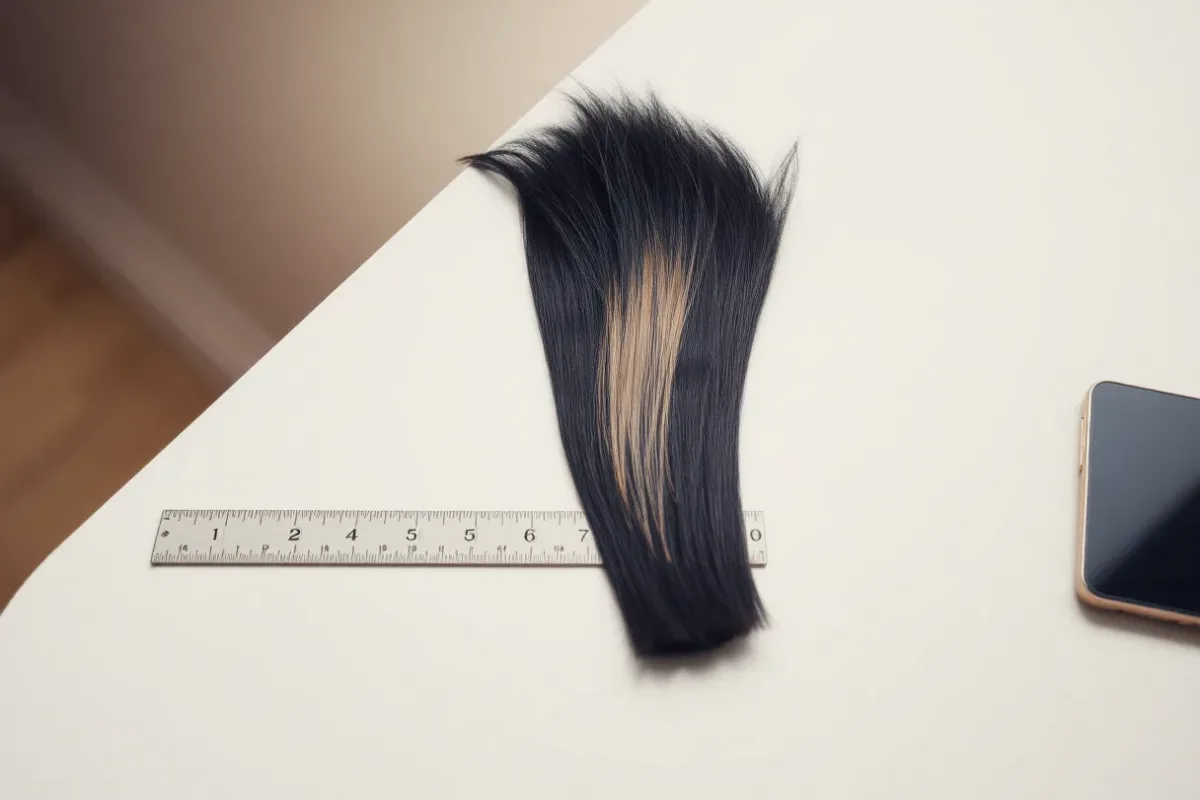
Two to three weeks can nearly always be covered without it showing. The tools are cheap and simple.
- Root spray or root powder: covers for a day and washes out. Choose one shade lighter than your colour.
- Move the parting: a zigzag or a side parting exposes far less root area.
- Texture instead of sleek: waves break the line, poker-straight hair emphasises it.
- A dark headband or scarf: covers exactly the zone that shows first.
- Deeper face-framing pieces: permanently adds two to four weeks to the interval.
One rule people get wrong with root powder: apply it to dry hair and do not brush afterwards. Brushing spreads pigment into the lengths and leaves a matte film. It also does not survive rain.
If you want to extend the interval permanently, change the technique rather than the workaround. Blending greys describes the methods that never create a hard line in the first place.
Colouring roots at home between appointments
Plenty of people do it, and it is not automatically a disaster — but it is where most salon corrections begin. If you go that route, three rules keep it recoverable. Apply only to the new growth and stop where the old colour starts. Never sweep the leftover product through the lengths to use it up. And keep to the same shade family as the salon colour, because a box shade two levels off will show as a band the moment the salon colour is applied over it.
Tell your stylist what you used and when. It is not a confession, it is information they need in order to choose a developer strength that will not lift unevenly across two different products.
Related articles
What it costs across a year
Convert the interval into appointments per year and the decision gets clearer. A root colour commonly costs between 75 and 130 dollars.
- Every 4 weeks: 13 appointments, roughly 975 to 1,690 dollars a year.
- Every 6 weeks: 8 to 9 appointments, roughly 600 to 1,170 dollars.
- Every 8 weeks: 6 to 7 appointments, roughly 450 to 910 dollars.
- Balayage with toners: 2 lifts and 4 toners, roughly 560 to 1,100 dollars.
Those are ranges for orientation, not quotes. What makes up the price and why two salons differ is covered in why prices vary. At salons that take online bookings the follow-up can usually be booked straight after the appointment, which keeps the interval more stable in practice than good intentions do.

When roots suddenly show sooner
If the interval feels shorter than it used to be, hair growth is rarely the reason. Three causes are more common.
The grey percentage has crept up. It happens gradually, and because white hair has no base colour of its own, every millimetre registers.
The colour in the lengths has faded and now sits further from your natural base than it did on the day of the appointment. Why that happens is covered in why colour fades.
Or the parting has moved, or you have started wearing the hair straight. Both expose more root area than before.
When the root goes lighter instead of darker
One effect confuses many people: on dark-coloured hair the root sometimes looks warmer and lighter than the lengths, even though it is the natural colour. That is scalp heat making colour develop faster there, combined with lengths that have deepened through repeated colouring. The term is hot roots.
The fix is not to colour the root darker but to change the application: start a centimetre away from the scalp and apply the last millimetres at the end. Salons do this as standard; at home it is the second most common mistake after overlapping.
Four to ten weeks is the realistic span, and where you fall in it depends on contrast and grey percentage. If you want a longer interval, change the technique rather than your willpower. A consultation about softer transitions is worth having before the next appointment rather than after it.
Booking your next cut without a phone call?
This link is meant for your salon, not for you. If you would rather book online than wait for a callback, pass it on at your next appointment.