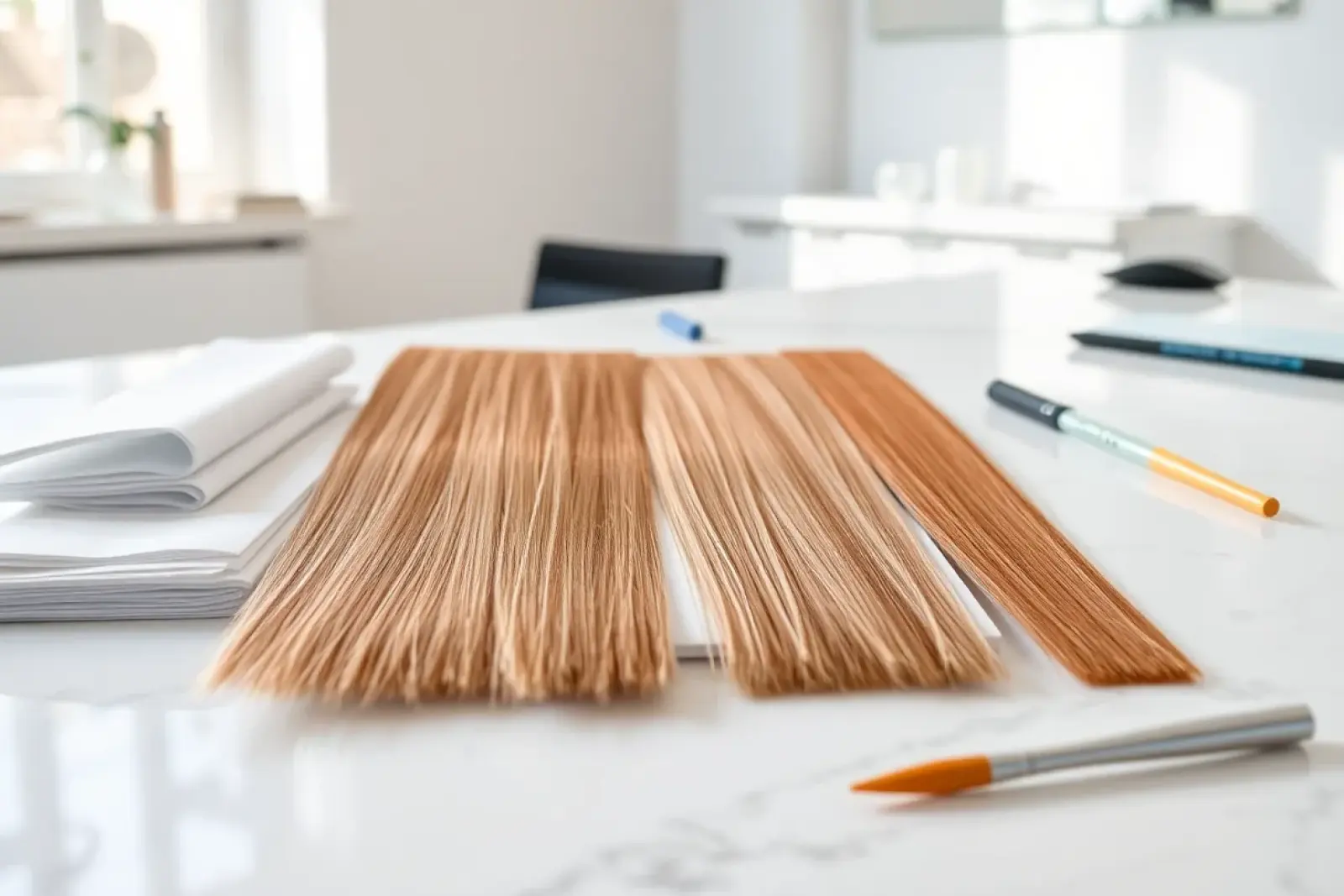
The transition takes as long as your coloured hair needs to grow out: one to one and a half years for a chin-length bob, two to three for long hair. There are three routes — grow it out, cut it short, or have the lengths blended to the grey in the salon. The third shortens the awkward phase to months.
The hardest part is neither the beginning nor the end but the middle: the point where five to ten centimetres of grey sits on coloured lengths and both are equally visible. People who plan for that phase cope with it far better than people it takes by surprise.
Grey is also not one thing. What we call grey is a mixture of pigmented and white hair, and the proportion rises over years. How it reads depends heavily on the contrast to the rest of your colour and on how the hair reflects light.
How long it really takes
Work with 1 to 1.5 centimetres of growth a month, or 12 to 18 centimetres a year. Subtract whatever you trim in that time — and you should trim, because coloured and uncoloured hair look different and cutting is the only way to remove the coloured zone.
| Starting length | Until fully grey | Awkward phase |
|---|---|---|
| Pixie, 5 cm | 4 to 6 months | about 2 months |
| Chin-length bob, 20 cm | 12 to 18 months | 4 to 6 months |
| Shoulder length, 35 cm | 20 to 28 months | 6 to 9 months |
| Long, 50 cm | 30 to 40 months | 8 to 12 months |
| With salon blending | unchanged | 2 to 4 months |
When to start
The best moment to begin is right after a colour appointment, not before one. It sounds backwards but it is practical: the lengths are even and fresh, and you have the full six to eight weeks before anything shows. Starting in the middle of an already grown-out root means half the awkward phase has begun without you noticing.
Autumn and winter tend to be easier starting seasons. Less sun means less yellowing in the new white growth, and hats and scarves are in use anyway.
Ignoring the transition does not make it shorter, but planning it makes it considerably easier.
The three routes compared
Grow it out
The cheapest and slowest route. You stop colouring and trim the ends every ten to twelve weeks. People who cope well with it easily save 1,500 dollars or more in colour appointments across two years. People who struggle with the middle phase most often give up here.
Cut it short
The fastest route. A pixie or short bob removes a large share of the coloured length at once and the transition is over within months. The price is a haircut decision you cannot undo and a shorter cutting interval of four to six weeks.
Blend it in the salon
The middle route and the most popular one. The stylist puts lighter pieces into the coloured lengths so the contrast with the grey root shrinks, usually with fine foils or lightening plus a silver toner. The awkward phase shrinks to two to four months. It costs 250 to 600 dollars once, often across two appointments, and it does stress the hair because lifting is involved — see how damaging bleaching is.
The tempting shortcut that backfires
Many people try to bridge the transition with a dark toner over everything. It works for four to six weeks, then the grey root is back — and because the toner fades unevenly, the contrast often ends up worse than before. If you take this route, ask specifically for a demi-permanent without lift rather than a permanent colour: permanent colour recreates exactly the hard line you were trying to lose.
Which options exist between full colour and doing nothing is covered in blending greys.

Grey hair behaves differently
White hair has no melanin left, and that changes more than the colour. It is often wirier because the structure is coarser, and it reacts more sensitively to the environment, because pigment also acted as protection.
- Yellowing comes from sun, smoke, minerals in the water, heat and styling products.
- Purple shampoo once or twice a week, 2 to 5 minutes. Details in how to use purple shampoo.
- Moisture matters more than protein, because grey hair reads dry rather than brittle.
- Heat stays at 150 to 180 degrees; white hair yellows faster at high temperatures.
- Shine on grey hair comes from a closed cuticle, so a cool rinse is visibly worth it.
One clarification that is often missing: purple shampoo does not make hair silver. It removes yellow, and nothing more. A cool silver your own white does not contain has to come from a salon toner, which needs redoing every four to six weeks — which puts appointments back into a transition you may have started to avoid them.
Water quality matters more than people assume. In hard-water areas, minerals settle on the hair and create precisely the dull yellowish veil that gets blamed on age. A shower filter, or a clarifying treatment in the salon every few months, changes that more visibly than any extra product.
Related articles
The cut carries the transition
During the phase where two colours are visible at once, the haircut decides whether it reads as intentional or as neglected. Layers and movement break the horizontal line between grey and coloured. A blunt bob worn poker-straight emphasises it.
Bangs are a strong tool here: they pull attention forward while covering the zone that shows first. What to consider before committing is in should you get bangs.
Plan shorter cutting intervals during this period, eight to ten weeks rather than twelve. At salons that take online bookings you can see availability in advance and lay the whole series out for a year at once.

What keeps people from giving up
Most people abandon the transition between month four and month eight. Three things reliably help.
First, an interim goal instead of an end goal. Not fully grey in two years, but grey to the chin by summer. Second, photographs in the same light every four weeks — progress is invisible in the mirror and obvious in a photo. Third, adjusting the palette around it. What suited warm brown often reads washed out next to silver, and cooler tones in clothing and make-up change the effect more than any product does.
One practical point: if a big occasion falls in the middle of the transition, a demi-permanent toner over the coloured lengths lasts 4 to 6 weeks and washes out without creating a new line.
The transition lasts as long as your hair is long, but the uncomfortable stretch can be cut from months to weeks. If cutting short is not for you, have the blending consultation before you start rather than halfway through, when two zones are already in the hair.
Booking your next cut without a phone call?
This link is meant for your salon, not for you. If you would rather book online than wait for a callback, pass it on at your next appointment.