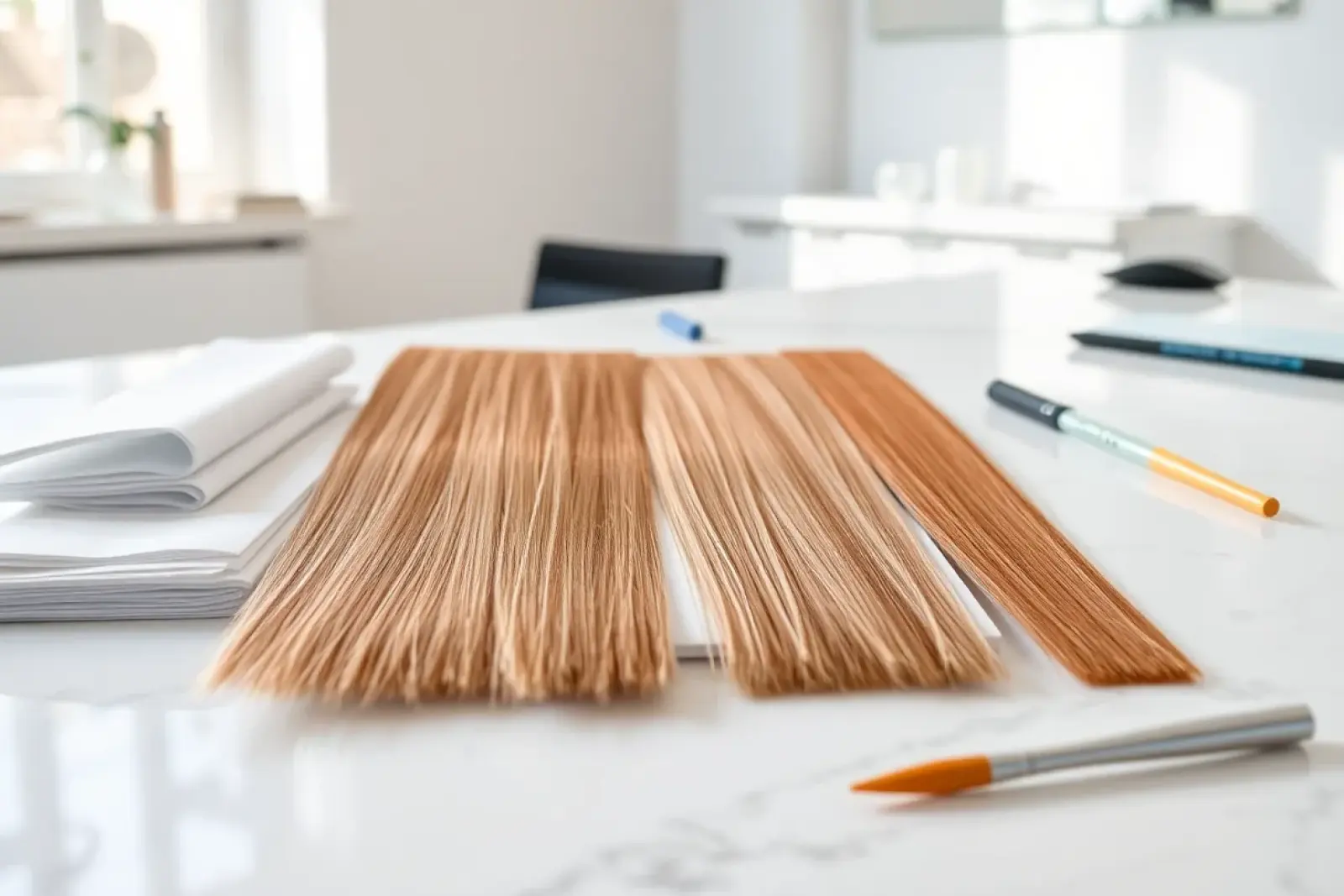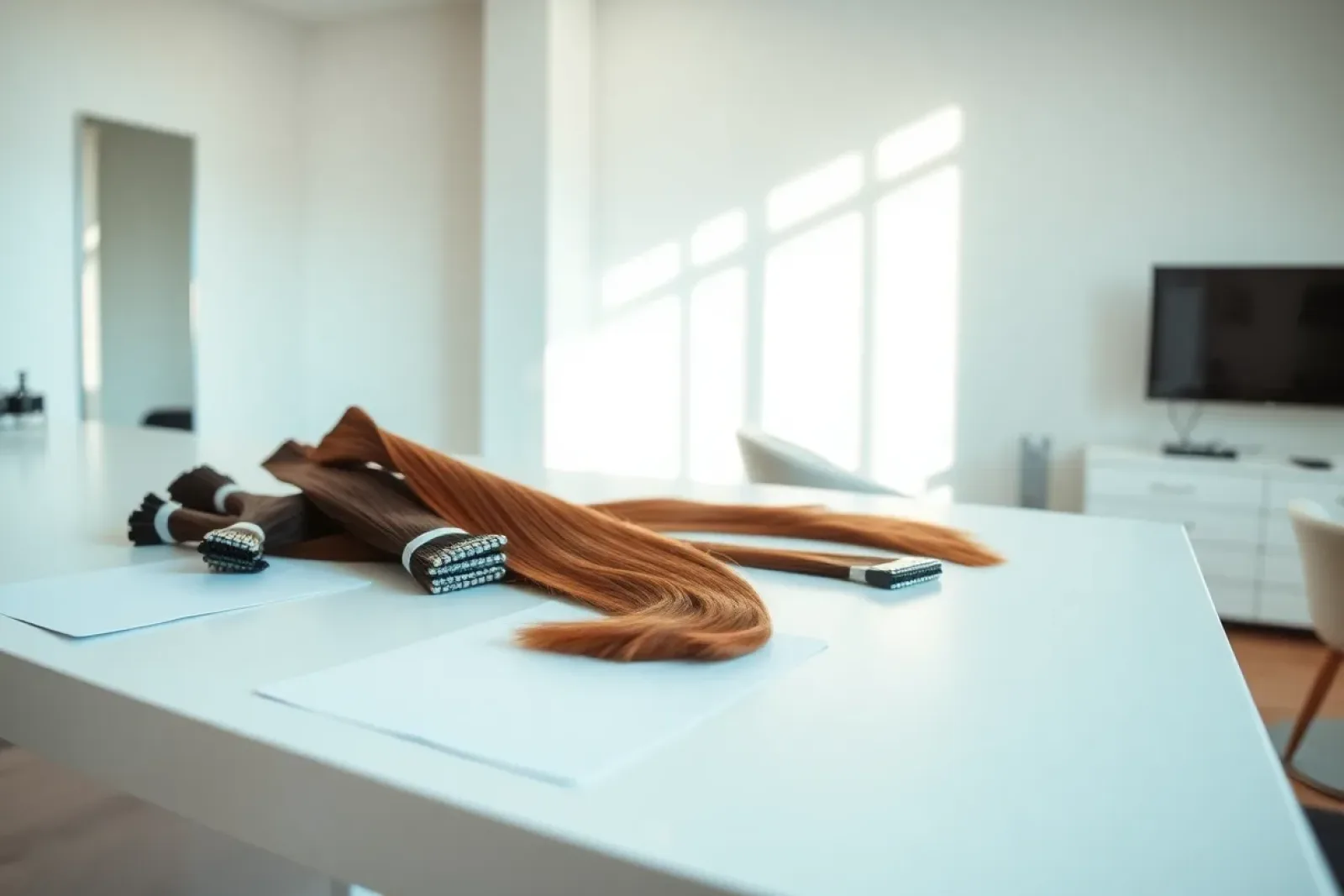
For occasional wear, clip-ins are the answer. For everyday wear choose tape extensions on fine hair and keratin bonds on thicker hair. Tapes have to be moved up every six to eight weeks, bonds every three to four months. A full head usually weighs 100 to 150 grams.
The method question usually gets asked too early. Before tape or bonds comes into it, three other things decide the outcome: how thick your own hair is, how often you can realistically come in for a move-up, and whether you want to wear extensions daily or only for occasions.
Answer those and one or two methods select themselves. Every technique does the same job, but they differ in how they attach, how much weight sits on each connection point, and how visible they become as your own hair grows.
The five methods at a glance
Clip-ins. Wefts with small pressure clips that go in each morning and come out each evening. No salon commitment, no move-up appointments, no strain on the roots. In exchange, daily effort, and hard to conceal on fine hair.
Tape extensions. Two thin adhesive strips are pressed together with a fine section of your own hair between them. Flat, invisible under thin hair, fast to fit — a full head takes roughly 60 to 90 minutes. Has to be released and re-taped every six to eight weeks.
Keratin bonds. Small strands with a keratin tip are attached to your own hair with heat. They last three to four months, move very freely and can be placed anywhere. Fitting takes two to four hours, and every bond is a single point of contact, which pulls more on very fine hair than a flat tape does.
Micro rings. Strands are clamped to your own hair with a tiny metal ring, with no glue and no heat. They last eight to ten weeks and are popular with sensitive scalps, because no solvent is needed for removal. On very straight hair the rings can slip.
Sewn-in wefts. A continuous weft is sewn onto a braided track. Robust, well suited to dense, strong hair, poorly suited to fine hair. Move-ups every six to eight weeks, because the braid grows out with the hair.
The method follows your own hair, not your target length — anything else ends in a compromise at the first move-up.
The direct comparison
| Method | Move-up | Suits |
|---|---|---|
| Clip-in | none, removed daily | occasions, trials, medium to thick hair |
| Tape | every 6 to 8 weeks | fine to medium hair, flat finish |
| Bonds | every 3 to 4 months | medium to thick hair, lots of movement |
| Micro ring | every 8 to 10 weeks | sensitive scalp, wavy hair |
| Sewn weft | every 6 to 8 weeks | dense, strong hair |
Price follows the amount of hair and its quality rather than the method alone. A full head commonly starts around 500 dollars for the fitting plus the hair itself, and move-ups run 100 to 350 dollars depending on method. Those are ranges for orientation.
Why the move-up intervals differ so much
It is not about how firmly the attachment holds but how far it travels. Your own hair grows about 1 to 1.5 centimetres a month, and the attachment moves away from the scalp at exactly that rate. Past a certain distance it becomes visible, it twists when you brush, and it pulls harder because the lever is longer.
Tapes are flat and wide, so they show sooner; bonds are small and round and stay hidden under the top layer for longer. That is why tapes need moving far more often even though the adhesive would still hold. Letting the appointment slide risks matting at the attachment point, and untangling that takes longer and costs more than the move-up would have.
The head-to-head between the two most common methods is covered in tape-in vs bonded extensions.
How much your own hair can carry
This is the decisive question and it rarely gets asked out loud. Extensions hang from your own hair, and every attachment carries weight. If your hair is fine or sparse, that weight rests on very few strands — and that is exactly where tension builds.
A full head usually weighs 100 to 150 grams. On fine hair a partial set is therefore common: 40 to 80 grams placed across the lower half of the head, where the top layer conceals it.
When extensions are not the right answer
- Visibly thinning hair at the parting — other solutions sit better, see toppers for thinning hair.
- Active shedding or an unexplained change in density. That belongs with a doctor first, see hair loss.
- Badly over-processed hair after repeated bleaching. Extensions add load to hair that already has none to spare.
- Any scalp condition with itching, redness or flaking.
- Very short hair, under roughly ten centimetres — the attachments cannot be concealed.
A reputable technician will say no in these cases. If nobody raises the subject of weight and your hair's condition at the consultation, that is itself information about the appointment you are about to book.
Related articles
Hair quality, origin and lifespan
What matters most in the hair itself is whether the cuticle runs in one direction. Hair like that is described as Remy, and only there do the strands survive daily wear without matting within weeks. Hair without that alignment is cheaper but turns dull after a few washes and becomes almost impossible to detangle.
Pre-treatment is the second criterion. Very light extension hair has almost always been lightened, which makes it more porous — it needs the same care as bleached hair of your own and lasts less time. Dark, untreated hair has the longest lifespan.
Synthetic, blended and human hair
Synthetic hair is far cheaper but tolerates no heat and cannot be recoloured. It reflects light differently, which nobody notices on clip-ins for one evening and everybody notices in daily wear. For permanent sets it is not a serious option, because every wash dulls it further.
Blended hair combines the two and is the most common quiet compromise in very cheap offers. Salons test for it by burning a single strand: human hair crumbles to ash and smells of burnt horn, synthetic melts into a hard bead. If you buy online, ask for that check before fitting.
Realistically, good extensions last six to twelve months when cared for properly and moved up repeatedly. That puts the purchase price in perspective: across a year, good hair often costs less than cheap hair bought twice. How to handle it day to day is covered in caring for extensions.
What to settle before the first appointment
Ask four things at the consultation: how many grams are going in, how many attachment points that means, how long the fitting takes, and how removal is done. The last one matters most, because removal is where most damage happens when it is rushed.
Settle the colour question too. Extensions are matched to your colour before fitting; afterwards they can barely be recoloured and cannot be lightened at all. If you plan to go lighter in spring, do it before the fitting rather than after.
Budget more time than you expect. Bonds take two to four hours, plus the cut that blends them into your own length — and that cut is not optional. Unblended extensions are the single most common reason a set looks obviously artificial.
At salons that take online bookings you can see the time allocated in advance and book the move-up at the same time, which keeps the interval steadier in practice than good intentions do. Whether extensions harm your own hair is a separate question, answered in do extensions damage your hair.
Occasional wear means clip-ins. Everyday wear means tape on fine hair and bonds on thick hair. A sensitive scalp points to micro rings, very dense hair to sewn wefts. If you are unsure, book a consultation that includes a weight assessment before you order any hair — that order is the hardest part to undo.
Booking your next cut without a phone call?
This link is meant for your salon, not for you. If you would rather book online than wait for a callback, pass it on at your next appointment.