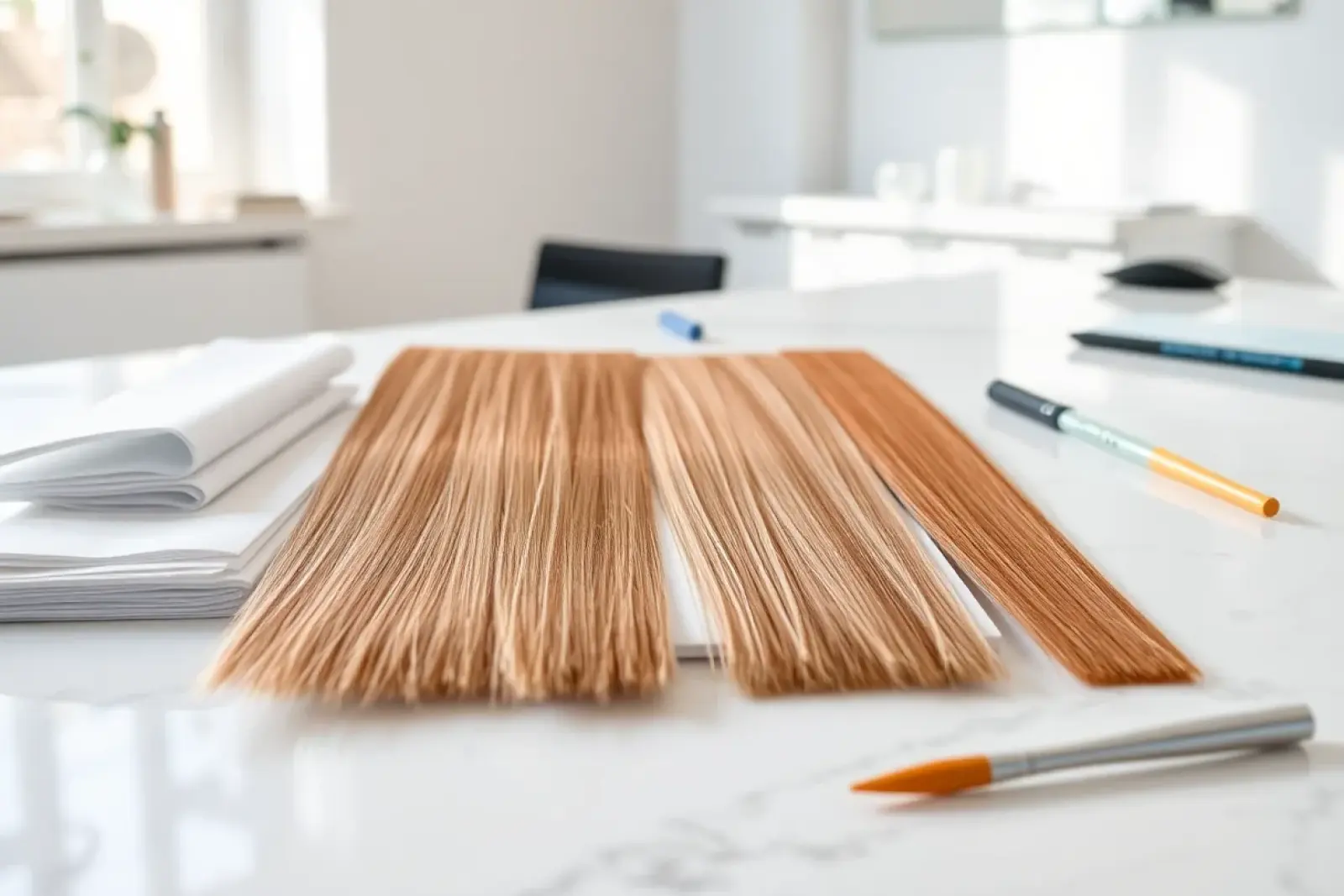
Short cuts need an appointment every four to six weeks, mid-length hair every eight to twelve, long hair every ten to sixteen, and bangs every two to four. What decides it is whether you are holding a shape or building length — when building length the interval can be longer.
The question has two answers because it serves two goals. If you wear a shape — a bob, a pixie, layers with a defined outline — you cut so the shape survives. If you are growing length, you cut so the ends do not split and undo at the bottom what the roots are producing at the top.
In between sits a stubborn myth: that frequent cutting speeds up growth. It does not. Hair grows from the root, not from the end, and scissors never reach the root.
Intervals by shape
| Cut | Interval | Why |
|---|---|---|
| Pixie and undercut | 4 to 6 weeks | the outline loses shape after 2 cm |
| Bob with a clean line | 6 to 8 weeks | the line goes uneven as it grows |
| Mid-length layers | 8 to 12 weeks | layers shift slowly |
| Long hair, holding shape | 10 to 12 weeks | ends and outline |
| Long hair, growing out | 12 to 16 weeks | ends only, 1 to 2 cm |
| Bangs | 2 to 4 weeks | one centimetre changes the effect |
Work with 1 to 1.5 centimetres of growth a month. A pixie has grown up to two centimetres in six weeks, which is a lot on a shape whose outline sits at three.
The table also explains why short cuts cost more per year than long ones despite the cheaper appointment. Ten appointments at 55 dollars beats four at 85 dollars. If you want to keep the workload low, the decision is about the shape rather than the price per visit.
And it explains a second effect: the cleaner the line, the harder the deadline. A precisely cut bob looks best on the day and declines from there. A soft layered cut often looks better in week four than in week one, because it settles.
Cutting does not speed up growth. It only stops the bottom losing what the top produces.
Growing length: the actual arithmetic
People who want length often think cutting is counterproductive. The maths works out differently.
Hair grows 12 to 18 centimetres a year. Taking one to two centimetres off every twelve weeks costs four to eight centimetres, leaving four to fourteen centimetres of net gain. Cutting nothing costs nothing at the scissors, but the ends split and eventually break off by themselves. The breakage travels upwards, and in the end more has to come off than two years of regular trims would have taken.
There is a second point that rarely gets said: hair does not grow indefinitely. Each hair has a growth phase of roughly two to six years, then sheds and is replaced. With a three-year phase at 15 centimetres a year, that caps out around 45 centimetres regardless of how good your care is. Anyone chasing a length they have never had before eventually meets that limit rather than a care mistake.
The practical route is one centimetre every twelve to sixteen weeks, stated explicitly as a trim and not a reshape. Say it at the start of the appointment, not as an aside halfway through. How to recognise split ends and how far up they reach is covered in split ends: cut or treat.

What shortens the interval
Some starting points call for more frequent appointments regardless of shape. If you lighten regularly, read the link in how damaging bleaching is alongside this — that is where the need comes from.
- Bleached hair: more porous, splits sooner — 8 to 10 weeks rather than 12.
- Daily heat styling: speeds up splitting noticeably.
- Fine hair: shows frayed ends sooner than coarse hair.
- Very short nape outlines: visually grow out fastest of all.
- Curly hair: needs fewer cuts but more precise ones — see cutting curls.
The dry trim in between
Many salons offer a dry ends trim without washing or blow-drying. It takes 15 to 25 minutes, costs correspondingly less and is exactly right when only a centimetre needs to go. Ask for it — the service list usually shows only the full cut.
A dry trim has an extra advantage: you see how the hair actually falls. Hair cut wet draws up as it dries, by as much as a quarter of the length on wavy hair. Anyone who has ever been surprised by how short it looked after the blow-dry has met that effect.
Related articles
What it costs and how that adds up
A women's cut and blow-dry commonly sits between 50 and 100 dollars, a men's cut between 25 and 50. A plain trim without a blow-dry is cheaper in many salons.
- Pixie every 5 weeks: around 10 appointments a year.
- Bob every 7 weeks: around 7 appointments.
- Long hair every 14 weeks: around 4 appointments.
- Bangs every 3 weeks on top: many salons trim them cheaply or free between visits.
A calculation that surprises people: someone with a pixie often spends more on cuts across a year than someone with long hair spends on cuts and colour combined. Short shapes are low effort day to day but appointment-heavy, and that is the real price of the shape.
One more thing worth knowing about timing: if you were unhappy with the last cut, do not wait longer, go back sooner and say so. Most salons will adjust within two weeks and usually without charge. After that the cut has grown out and the cause can no longer be traced.
The bang trim is the most common reason for an in-between visit and the easiest to forget. At salons that take online bookings a short slot like that can usually be picked up from a gap without phoning. What drives the price differences is covered in why salon prices vary.
How to tell it is time
Four signs beat the calendar entry.
The style no longer falls into shape by itself in the morning but has to be forced. On shaped cuts that is the first signal.
The ends feel dry while the mid-lengths feel soft. Dry ends on otherwise conditioned hair almost always mean lost substance at the end rather than a care deficit.
The hair looks thinner at the bottom than in the middle, which means the ends are fraying and losing density.
And it tangles in the same places every time, because roughened ends hook into each other.
If none of these appear, postponing is fine. Healthy, lightly styled hair needs scissors less often than the calendar suggests. On very thick hair one more question arises: whether thinning is sensible or whether only weight should come out. The difference is in thinning thick hair, and the short shapes are compared in bob, lob or pixie.
Four to six weeks for short shapes, eight to twelve for mid-length, ten to sixteen for long, two to four for bangs. If you are growing length, stretch the interval and restrict the cut explicitly to the ends. The simplest way to hold the rhythm is to book the next appointment as you leave.
Booking your next cut without a phone call?
This link is meant for your salon, not for you. If you would rather book online than wait for a callback, pass it on at your next appointment.