The basic routine has five steps: gentle cleansing once or twice a week, detangling with conditioner in the hair, applying leave-in and gel to soaking wet hair, drying with a diffuser or air, and protecting the curls overnight. The order matters far more than the number of products.
Curly hair is not drier because it receives less moisture. It is drier because sebum from the scalp travels down a coiled shaft far less easily than down a straight one. Everything else in the routine follows from that single fact.
Which is why advice written for straight hair often reverses here: wash less rather than more, apply product to wet rather than towel-dried hair, do not comb rather than brush, and leave it alone rather than arrange it.
Steps one and two: cleanse and condition
Wash curly hair about once a week, every ten days if it is very dry, twice a week if the scalp gets oily. A mild shampoo is enough, applied to the scalp rather than the lengths — the water running down does the rest.
Between washes a co-wash is an option: washing with conditioner only. It cleanses less aggressively and preserves more moisture. Every four to six weeks a clarifying shampoo should still be used, or product residue builds up and the curl goes limp.
That is the most common reason a routine suddenly stops working after two months. The product has not stopped performing; there are simply four layers of it in the hair. A clarifying wash resets it, and the next wash feels like the beginning again.
Conditioner stays on for two to five minutes. Detangle right then, with a wide-tooth comb or your fingers, while the hair is wet and the conditioner is still in — that is the only moment curls should be combed. Rinse afterwards, but not squeaky clean. The difference between conditioner and mask is covered in conditioner or mask.
Curls are formed while wet. Once dry, they can only be disturbed.
Step three: apply to soaking wet hair
This is where most routines fail. Product belongs in dripping wet hair, not in towel-dried hair. Water is the carrier that forms the curl; anything applied without it simply sits on top.
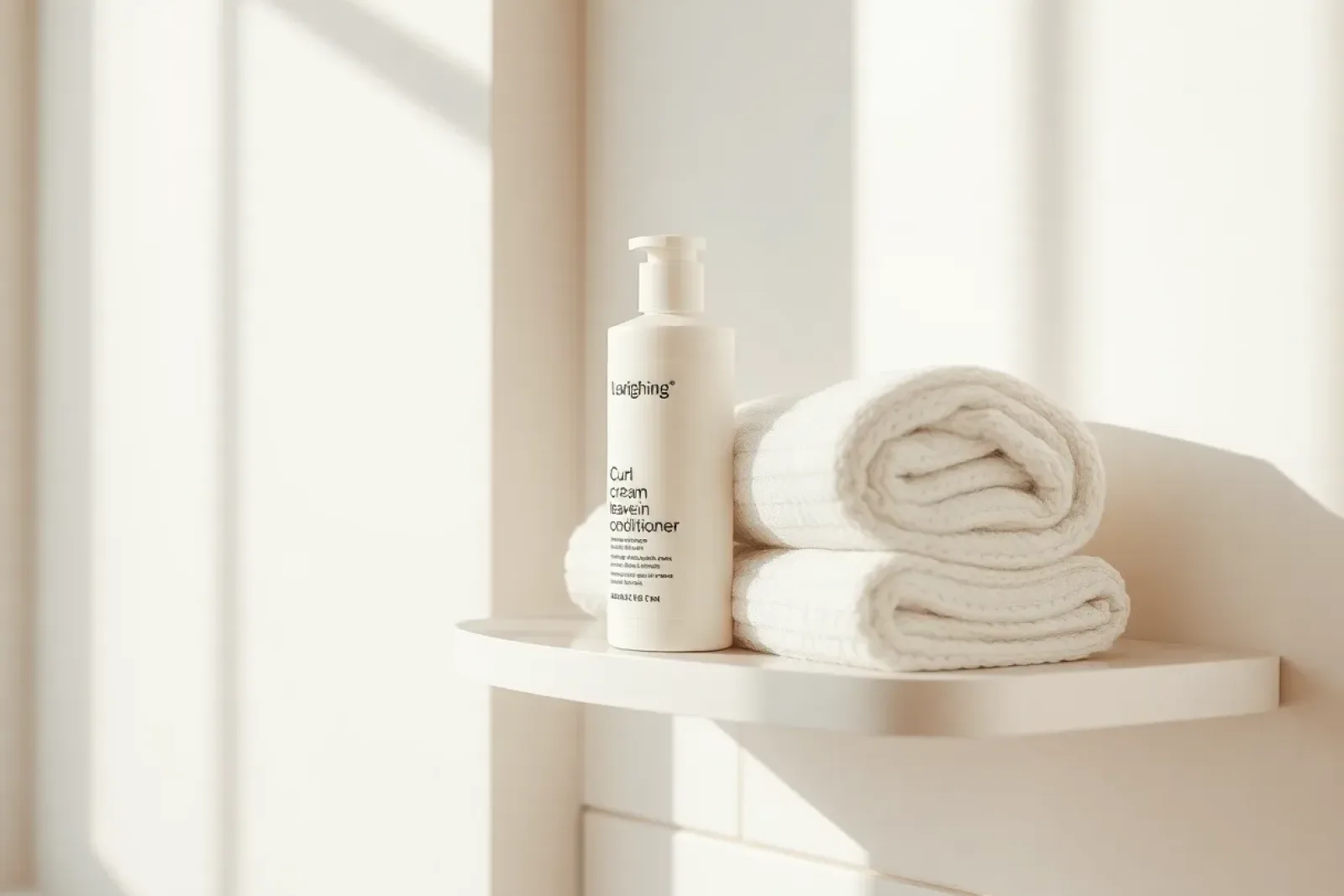
The order is leave-in, then a curl cream, then gel. It is not stroked through but pressed in — palms pushing upwards from the ends so the curl concertinas.
| Product | Amount at shoulder length | Purpose |
|---|---|---|
| Leave-in | 2 to 3 pumps | holds moisture |
| Curl cream | hazelnut sized | definition and slip |
| Gel | walnut sized | a cast that holds the shape |
| Oil | 2 to 3 drops | finish only, optional |
| Mousse | fist-sized portion | gel alternative for fine hair |
Gel forms a hard cast as it dries. That is intended: it protects the curl until it is completely dry. Afterwards the cast is broken by scrunching the hair gently between your palms. Treating that cast as a sign of too much gel and breaking it early is what produces frizz instead of definition.
Two application techniques help further. Raking pulls the product through with spread fingers before scrunching, which distributes more evenly than palms alone. And praying hands slides product down the section between two flat palms, which costs the least volume on fine hair.
Step four: drying without wrecking the shape
Wet curls are formable, half-dry curls are fragile, dry curls are finished. Every touch during the middle phase creates frizz.
- Plopping: lay the wet hair into a cotton T-shirt or microfibre wrap for 10 to 20 minutes. It absorbs water without rubbing.
- Air drying: the gentlest option, two to four hours on dense hair.
- Diffuser: low speed, medium heat, hair cupped and lifted rather than moved around.
- Cool shot at the end: closes the cuticle and sets the shape.
- Hands off: between wet and dry, touch as little as possible.
How long it really takes
Budget two to four hours for air drying on dense hair, 20 to 40 minutes with a diffuser. If mornings are tight, wash in the evening and dry overnight — but with protection, or the shape will be flattened by morning.
A middle route that gets overlooked: 15 minutes on the diffuser until the hair is roughly 70 percent dry, then air dry. That cuts the time substantially while keeping heat exposure low, because the critical final minutes happen off the tool. Why frizz forms in this phase at all is covered in how to control frizz.
Related articles
Step five: day two and day three
Curls are supposed to last several days, otherwise the routine is too much work. Night is the critical point.
Gather the hair loosely on top of the head with a soft, metal-free tie, or wear a bonnet. A satin or silk pillowcase cuts friction dramatically compared with cotton.
In the morning you refresh rather than restyle: water from a spray bottle into your palms, optionally a drop of leave-in, then press it into the curls from below. Adding product without adding water gives you weight instead of definition.
What makes refreshing practical
A small spray bottle of water with a dash of leave-in, kept by the sink, is the most useful purchase in this whole routine. Spray into your hands rather than at the hair — sprayed directly, the water lands unevenly and only partly reactivates the shape.
If you are in a hurry, refresh only what is seen: the front sections and the top. The back usually holds longer anyway because it is pressed less overnight. From day three the root is normally the problem rather than the length; dry shampoo works there, leaving the lengths untouched. More on that in oily roots.
What gets overlooked
Porosity matters more than curl type. Whether a curl is classed as 2b or 3a says little about what it needs. Porous hair takes up moisture fast and loses it fast and wants heavier products; low-porosity hair is weighed down by them.
Curls can be smoothed, but not for free. If frizz is the complaint and the curl is not, exhaust the routine before considering a keratin treatment — it removes both.
Protein and moisture alternate. Too much moisture leaves curls limp and shapeless, too much protein leaves them straw-like. One moisture mask a week and one protein treatment every three to four weeks is a reasonable starting point.
Hard water works against every routine. In hard-water areas minerals deposit in the hair and leave the curl stiff and dull. A shower filter or a clarifying treatment every few months does more here than another product. People who move house and suddenly have different curls have usually met exactly this.
The cut carries the routine. Without the right shape the best care achieves little, because weight drags the curl down. Whether to cut dry or wet is covered in cutting curls, and which shampoo fits in choosing a shampoo. If you are looking for a salon with curl experience, salons that take online bookings usually list curl cutting and curl consultations as separate services.
Cleanse gently, detangle with conditioner in, press product into soaking wet hair, let it dry undisturbed, protect it overnight. Those five steps carry most of the result. Stay with one routine for four weeks before changing anything — before that there is no way to tell what worked.
Booking your next cut without a phone call?
This link is meant for your salon, not for you. If you would rather book online than wait for a callback, pass it on at your next appointment.