A keratin treatment coats the hair and seals it in with heat. It removes frizz, cuts blow-drying time considerably and leaves the hair smoother, without permanently changing its structure. Depending on the product the result lasts eight to sixteen weeks, then grows and washes out.
The name is misleading. A keratin treatment is not a chemical restructuring like a perm or a relaxer, which break the bonds inside the hair and reset them. It lays a layer around the hair and fixes it with a flat iron. That is why the result is temporary — and why no hard line ever grows out.
Anyone expecting permanently straight hair will be disappointed. Anyone wanting less frizz, more shine and a shorter morning routine gets exactly that. The distinction matters, because salons often offer both services side by side under similar names.
What happens in the salon
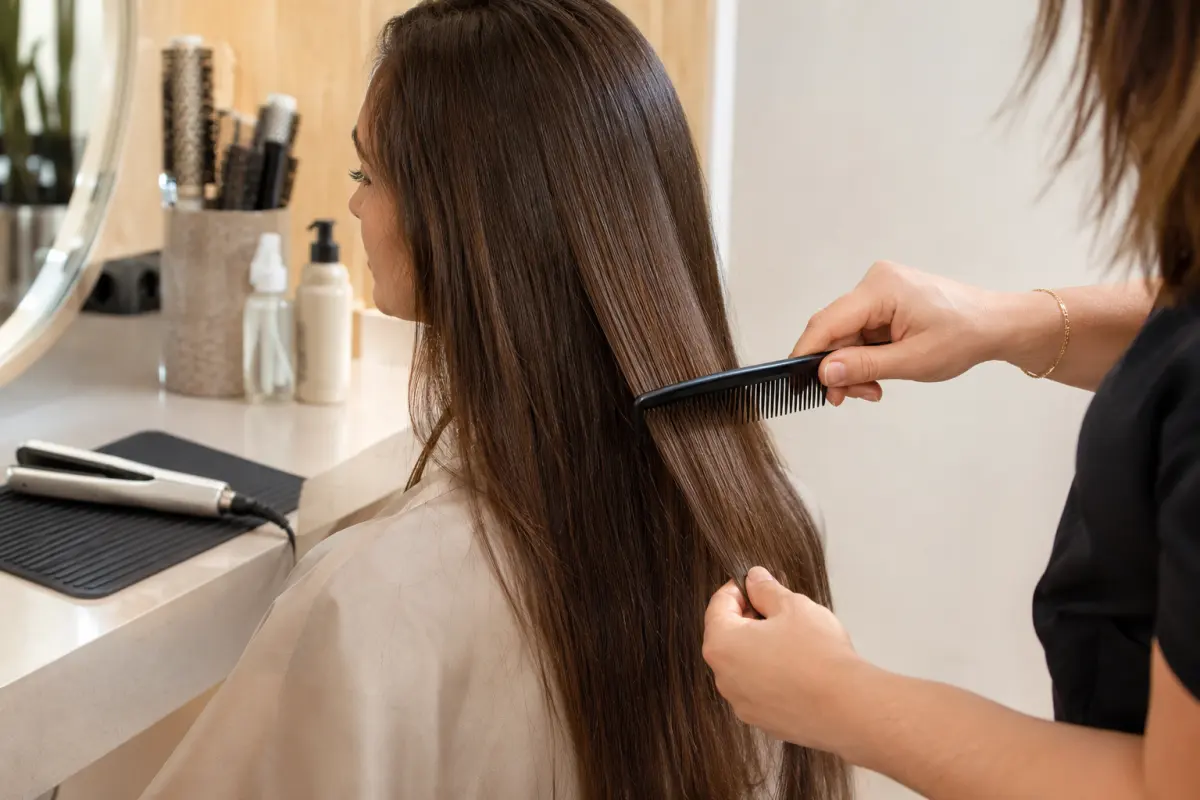
The sequence is much the same across products and takes two to four hours depending on length.
- A clarifying shampoo opens the cuticle and removes residue.
- Towel drying, then the product is applied in thin sections, usually about a centimetre away from the scalp.
- Processing, 20 to 40 minutes depending on the formula.
- Blow-drying until completely dry.
- Flat-ironing in very thin sections over several passes, usually at 200 to 230 degrees, which is the step that seals the product in.
Some formulas then require 48 to 72 hours without washing, without tying the hair back and without clips; others can be washed immediately. That instruction is printed on the product and it is the most important sentence of the whole appointment — every crease sets otherwise.
So book the appointment before two quiet days. A hat, a hair tie or sunglasses pushed into the hair will leave a visible bend that stays until the next wash. Exercise is unhelpful too, because sweat on the scalp acts like a small wash.
One practical note about the ironing step: the hair is passed through in very thin sections, repeatedly. If it feels too hot or pulls, say so. An experienced operator works at a lower temperature around sensitive areas such as the hairline.
A keratin treatment does not change what your hair is. It changes how your hair behaves.
What it delivers and what it does not
| Expectation | Reality | Note |
|---|---|---|
| Frizz disappears | yes, markedly | the strongest and most reliable effect |
| Drying time drops | often by half | usually the real everyday gain |
| Curls go straight | only partly | curls loosen rather than straighten |
| Permanently straight | no | grows and washes out |
| Damage is repaired | no | surface improves, substance does not |
| Volume stays | no | hair sits flatter to the head |
That last row surprises people: less frizz also means less body. If your hair is fine and you are chasing volume, other routes serve you better — see volume for fine hair.
Who benefits most
The clearest winners are thick, wavy, frizz-prone hair that gets straightened daily. There the treatment replaces a large part of the daily effort for weeks — and less daily heat is, on balance, gentler than the treatment itself is harsh.
It pays off least on fine, straight hair with little frizz, where there is nothing to gain, and on defined curls you want to keep: the curl does not get better, there is simply less of it.
How it differs from chemical relaxing
Both are called straightening in everyday speech and they have nothing chemically in common.
A relaxer breaks the disulfide bonds inside the hair and resets them in a straightened position. The result is permanent: treated hair stays straight until it is cut off, and a visible boundary appears at the root as natural hair grows in. That is why only the new growth is retouched every eight to twelve weeks.
A keratin treatment does none of that. It sits around the hair rather than inside it and fades with time. There is no root line and no root retouch.
The risks that come with the chemical route are set out in chemical relaxing risks. If your goal is curls that behave rather than curls that disappear, the routine in curly hair care is often the more effective answer.
Related articles
Ingredients: what to check
The effect does not come from the keratin but from a substance that cross-links the layer under heat. Historically that was formaldehyde. In the EU, formaldehyde is not permitted as an ingredient in cosmetics.
The ingredient list is still worth reading, because some compounds can release formaldehyde under heat. Look for methylene glycol and for any labelling stating that formaldehyde is released. A serious salon will name the product when asked and will work with extraction or good ventilation.
Formaldehyde is no longer the substance to watch for on its own. Most smoothing products now cross-link with glyoxylic acid instead, listed as Glyoxylic Acid or Glyoxyloyl Carbocysteine. It is not restricted under the EU cosmetics rules, so its presence is legal and says nothing about how well the product is tolerated: the French health agency ANSES advised against these treatments after cases of acute kidney injury, with lower back pain, nausea, headache, intense thirst and marked fatigue in the hours or days afterwards. The ingredient list alone will not settle it: among the products behind the French cases were some that did not declare the substance at all. Ask instead for the name of the exact product going on your hair and look up its INCI, and do not take a "formaldehyde free" claim as an answer to any of this.
A second point concerns the sealing temperature. Most products call for 200 to 230 degrees, which is above what hair is otherwise subjected to. That is defensible every few months, but on previously damaged or repeatedly bleached hair it is a real additional load. In that case a strand test before treating the whole head is sensible.
Two practical rules: if anything stings your eyes or irritates strongly during the service, say so immediately. And if you are pregnant or breastfeeding, postpone — not because of a demonstrated risk, but because reducing unnecessary exposure during that time is reasonable in general.
Ask as well whether the product suits coloured or bleached hair. Not all of them do, and sequence matters: colour before smoothing, not after, with about two weeks in between.

Aftercare and how long it lasts
Longevity depends less on the product than on what follows it. Sulphate shampoos dissolve the layer faster, and so do salt water and chlorine.
- Wash sulphate-free from the first day.
- Do not shorten the wash interval — every wash costs wear time.
- Avoid scalp scrubs and clarifying shampoos; they are designed to remove layers.
- Wet the hair before swimming and rinse thoroughly afterwards.
- No root appointment is needed as it grows out; the next treatment covers the whole length.
How the result tails off
A keratin treatment does not vanish in a day, it eases off. For the first weeks the hair stays smooth throughout, then frizz returns first at the hairline and the nape and last in the lengths. That is precisely why no visible line appears as with chemical straightening: the effect thins out instead of stopping at a border.
Do not wait until there is nothing left before booking again. On hair that is still partly sealed, the second application works more evenly. Two to three treatments a year is the usual pattern, and the price commonly sits between 250 and 500 dollars depending on length and product. At salons that take online bookings duration and price range are usually visible before you commit.
If frizz is your only real complaint, look at the simpler routes in how to control frizz first. A change of blow-drying technique sometimes covers it.
A keratin treatment buys you less frizz and less time, not a different hair type. Eight to sixteen weeks is realistic, sulphate-free care is not optional, and the ingredient list is a fair question to ask. If you are unsure it is the right service, ask the salon to weigh it against technique and care in the consultation.
Booking your next cut without a phone call?
This link is meant for your salon, not for you. If you would rather book online than wait for a callback, pass it on at your next appointment.