Wait 48 hours before the first wash, then wash no more than two or three times a week in lukewarm water with a colour-safe shampoo, use purple shampoo once or twice weekly for two to five minutes, and use a mask once a week. Keep hot tools below 180 degrees.
After a balayage there are two different things in your hair that need different care. The lightened pieces are more porous than the natural hair beside them — they take up moisture quickly and lose it just as fast. Over all of it sits a toner that sets the shade and leaves a little with every wash.
A good routine handles both without becoming complicated. Four products are enough if you use them on the right rhythm: a mild shampoo, a purple shampoo, a mask and a heat protectant. Everything else is optional.
The first 48 hours
Straight after the appointment the cuticle has not fully closed again. During that window the toner sits at its loosest and every wash costs a disproportionate amount of colour. Showering the same evening rinses away a noticeable share of what you have just paid for.
In practice: no washing for 48 hours, no sauna, no pool, no hot water over the head. Do not tie the hair back tightly either — a bend set during this phase can show afterwards.
The second critical period is the first vacation after the appointment. Chlorine and salt water shift the tone within days, because hair absorbs whatever is dissolved in the water like a sponge. The most effective countermeasure is free: soak the hair in clean fresh water before swimming and work in a leave-in. Hair that is already saturated cannot take up pool water.
Rinse straight after swimming rather than in the evening. And if you swim regularly, a swim cap is inelegant but the only thing that reliably works.
A green cast after the pool, incidentally, does not come from chlorine but from copper that enters the water through the pipes and binds to porous hair. Ordinary shampoo barely touches it — you need a clarifying shampoo or a salon treatment that binds metals.
It is not the number of products that decides the result, but the rhythm in which they are used.
The weekly plan
The plan below assumes shoulder-length balayaged hair washed two or three times a week. It transfers to any frequency — what matters is the ratios, not the days.
| Step | Rhythm | Note |
|---|---|---|
| Mild shampoo | every wash | scalp only, the lengths rinse clean |
| Purple shampoo | 1 to 2 times a week | 2 to 5 minutes, start with 2 |
| Moisture mask | once a week | 5 to 20 minutes, lengths and ends only |
| Protein treatment | every 3 to 4 weeks | not on the same day as the mask |
| Leave-in | after every wash | into towel-damp hair |
| Heat protection | before any tool | including the hairdryer, not only irons |
What one wash actually looks like
Shampoo belongs on the scalp, not in the lengths. Massage it in with fingertips rather than nails and let the run-off clean the lengths — they need no extra surfactant. On an oily scalp, shampoo twice: the first pass loosens, the second cleans.
Then either conditioner or mask, on lengths and ends only. Squeeze, do not rub, and wrap in microfibre. Apply a leave-in to towel-damp hair and only then detangle, with a wide-tooth comb working upwards from the ends. Bleached hair is at its most fragile when wet, and most breakage happens in exactly those two minutes.
Purple shampoo: where it tips over
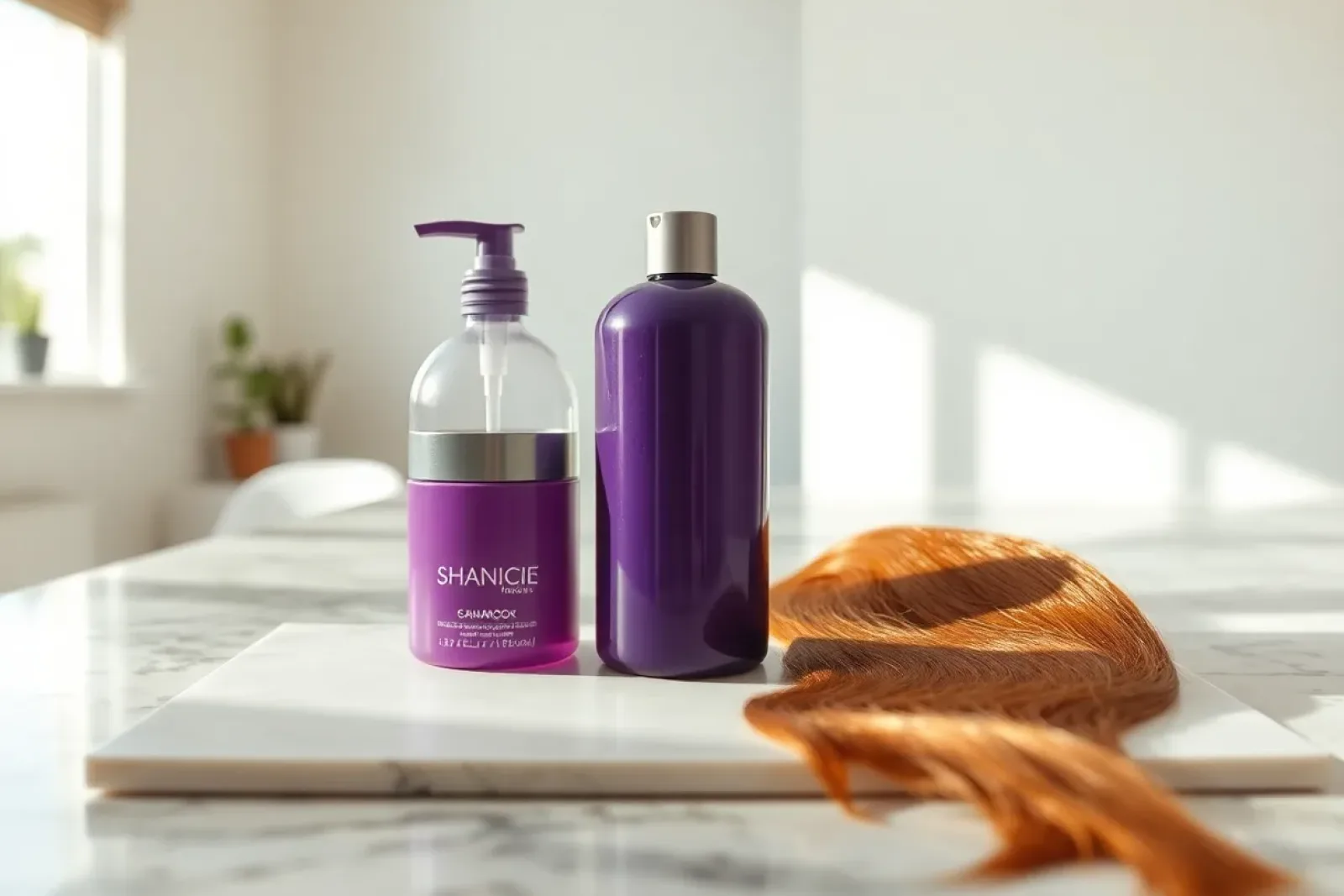
Purple shampoo carries violet pigment that optically neutralises the yellow in lightened hair. It does not lighten and it does not colour; it only corrects the direction of the tone.
Dosing is the whole trick. Once or twice a week, two to five minutes. Start at two minutes the first time and watch what happens — on very porous hair that is often already enough. Used daily, or left on for ten minutes, it leaves a lilac cast exactly where the hair is most porous: the ends.
If the lilac cast is already there
It usually washes out within two to four normal washes. A clarifying shampoo speeds that up, at the cost of depth in the rest of the tone. Do not try to counteract it with a yellow or golden product — that does not neutralise anything, it adds a second error.
On very pale balayage there is a gentler alternative: a purple conditioner rather than a purple shampoo. It is more weakly pigmented and much harder to overdo. The full method is in how to use purple shampoo.
Related articles
Moisture and protein in rotation
Bleached hair needs both, but not at the same time. Moisture gives slip and combability, protein gives structure and resilience. Too much moisture leaves hair limp and shapeless, too much protein leaves it straw-like and prone to snapping.
How do you tell which is missing? A simple test: stretch a wet hair gently. If it stretches a long way and does not return, protein is missing. If it snaps immediately without stretching, moisture is missing. If it springs back, the balance is fine.
- Mask: once a week, 5 to 20 minutes, on lengths and ends only.
- Protein treatment: every three to four weeks, exactly to the instructions — longer is not better here.
- Oil: two or three drops as a finish; it does not replace a mask.
- Home bond builder: useful after strong lifts, but not a substitute for conditioning.
- Leave-in: daily is fine, because the dose is light.
What separates a conditioner from a mask in the first place is covered in conditioner or mask.
Heat, sun and the wash interval
After wash frequency, the three biggest colour thieves are tool temperature, water temperature and UV.
For bleached hair the ceiling on a flat iron is 180 degrees. Keratin changes permanently from around 150 degrees and the risk climbs steeply above 200 — and porous hair reacts earlier than healthy hair. Use the dryer at 15 to 20 centimetres and finish on the cool setting, which visibly closes the cuticle.
What the wash interval is worth
Do the arithmetic once. Washing daily means 56 washes in eight weeks; every other day means 28. Since a demi-permanent toner lasts roughly 20 to 28 washes, that is the difference between a tone that turns after four weeks and one that holds for eight.
If daily washing is a fixed habit, there is a middle step: wash the roots only and leave the lengths out. Roots get oily, lengths do not — and the colour lives in the lengths. Dry shampoo bridges another day, applied at the root rather than through the lengths.
In summer a hat does more than any UV spray. And when you plan the next appointment, how long the colour lasts overall is covered in how long balayage lasts, and the causes of fading in why colour fades. At salons that take online bookings the short toner between two lightening appointments is usually bookable on its own, which costs a fraction of the full service.
Wait 48 hours, wash lukewarm and rarely, use purple shampoo sparingly, mask once a week, keep heat under 180 degrees. That is all it takes, and more does not help. If the tone still turns after four weeks despite the routine, a short toner in the salon is a better next step than another product.
Booking your next cut without a phone call?
This link is meant for your salon, not for you. If you would rather book online than wait for a callback, pass it on at your next appointment.