Lifting almost always traces back to one of four things: incomplete preparation of the nail, moisture or oil on the surface, product applied too thickly or onto the skin at the edge, and heavy everyday wear. Where it starts to lift usually tells you which of the four applies to you.
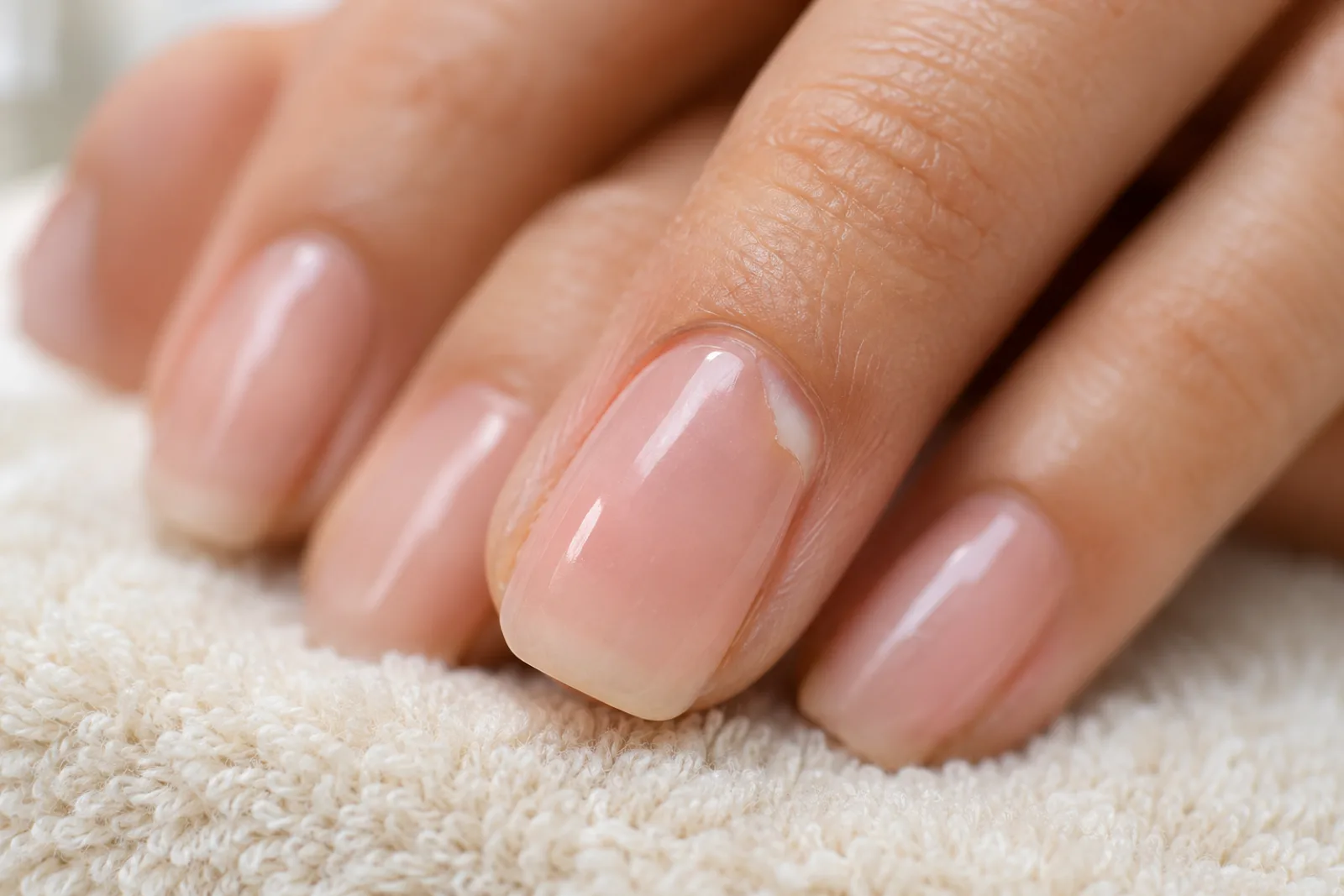
Lifting means the enhancement separates from the natural nail without breaking. You see it as a pale shadow under the layer, feel it as a ledge, and often notice it first while washing your hair, because water pushes underneath.
The frustrating part is that it is rarely one single mistake. Usually two small factors combine. So it pays to look systematically at where exactly it begins — the location gives away the cause.
1. What lifting actually is
There is no chemical bond between natural nail and product the way there is between two glued metal parts. Adhesion here is mechanical: a lightly roughened surface offers structure for the product to grip. That connection holds as long as nothing gets in between.
What can get in between is moisture, oil, dust or movement. As soon as a gap opens anywhere, every load acts on it like a wedge and the gap travels. Which is why lifting always spreads rather than staying put.
And it is why the single most important rule is: do not pick. A lifted edge that gets pulled takes the top layer of your nail plate with it. The nail gets thinner, and next time it lifts in exactly the same spot.
One distinction helps to place all of this: lifting and breaking are two different events. In a break the product gives way; in lifting the bond does. A broken nail is a one-off, a lifting nail is a process that keeps going. Lifting is therefore the observation worth reporting — it allows a correction, whereas a break can usually only be repaired.
Where the gel lifts first tells you more than any guess: at the cuticle, in the middle, or at the tip.
2. What comes down to preparation
For product to hold, the nail plate has to be dry, free of oil and free of skin residue. The most common invisible culprit is the thin layer of skin sitting on the nail, which can reach surprisingly far towards the middle. Leave any of it behind and the product is bonded to skin rather than nail — and skin renews itself.
The second factor is moisture. Sanitising or washing too shortly before the build leaves residual water in the plate. That is what a dehydrator is for, applied right before the product.
The third is dust. After filing, fine particles sit across the surface. If they are not brushed away properly, the product is resting on a layer of dust, and dust carries nothing.
Naturally sweaty hands are a special case. Moisture keeps coming through during the appointment even though everything was dry to start with. You can spot it because a pale haze appears under the layer within the first few days. The fix is a different primer, working faster in smaller sections, or a thinner first layer. It is no reason to give up on enhancements, but it is something your technician should know about you.

3. What comes down to the application
The nail fold is where three quiet weeks are won or lost. Product dragged onto the skin lifts there with the first bit of skin growth. A tiny margin between product and cuticle is not carelessness but intent — it should be visible under magnification, not to the naked eye.
The second variable is thickness. Too much product at the edge creates a step that catches on everything. Too little in the stress area lets the layer flex, and movement breaks adhesion from the inside.
Then there is curing. Layers applied too thickly do not cure all the way through. You will not notice immediately; it shows up a few days later as a broad area lifting even though the edge looks perfect.
The stress area plays its part as well. It sits where the nail leaves the fingertip, and that is where the greatest thickness of product belongs. If the apex is placed too far forward or too far back, the enhancement flexes at a point it should not with every grip. That rarely causes an immediate break, but it reliably produces lifting in the middle of the nail after two weeks or so.
Related articles
4. What comes down to your daily life
Even a perfectly built set has enemies. The main ones can be named — and most of them are within your control.
| Cause | Where it lifts first | What helps |
|---|---|---|
| Oil or cream on appointment day | broad areas, anywhere | only wash your hands that morning |
| Hot water, sauna, long baths | at the nail fold | let hands cool down afterwards |
| Cleaning without gloves | along the sides | household gloves |
| Using nails as tools | at the tip | use the pad, not the edge |
| Very flexible natural nails | in the middle | flatter build, shorter length |
Hot water is the most underrated item on that list. Nail and product expand at different rates, and every long hot soak works away at the bond a little more.
A frequently overlooked culprit is medication and hormonal change. Both can shift the moisture content of the nail plate, so a system that held perfectly for years suddenly stops sitting properly. That is nothing to be alarmed about and is usually temporary. What matters is mentioning it, so nobody goes hunting for a technique problem where the underlying conditions have simply changed.

5. When to raise it with your technician
One nail lifting at a corner after two and a half weeks is normal. Three or more nails lifting in the first week is not about your daily life — it is about the appointment before it.
Say so plainly and describe exactly when and where it started. That information is genuinely useful: broad lifting points to preparation, edge lifting to application, tip lifting to load. A good technician will work with it and adjust next time.
Until then, one rule: nothing gets peeled. If an edge catches, file it smooth or tape it down. Anything else costs you nail substance that will take months to grow out.
Keep a simple log for two cycles: appointment date, day lifting first appeared, which finger, which spot. After eight weeks a pattern jumps out of that short list — that it is always the thumbs, always after a weekend, always after a sauna visit. Those four lines are worth more in the next conversation at the salon than any general explanation.
Lifting nearly always has an explainable cause — preparation, application, heat or load — and the location gives it away. The most important part is what you do not do: pull. Make a note of the day and the spot where it started, and the problem can usually be fixed within a single cycle.
Booking your infill without a phone call?
This link is meant for your nail studio, not for you. If you would rather set your infill or a new set online, pass it on at your next appointment.