A lash lift curls your own lashes upwards for good, usually together with a tint. It lasts six to eight weeks, takes 45 to 60 minutes and needs no upkeep afterwards. What it does not do is make your lashes longer or denser — and that remains the whole difference to extensions.
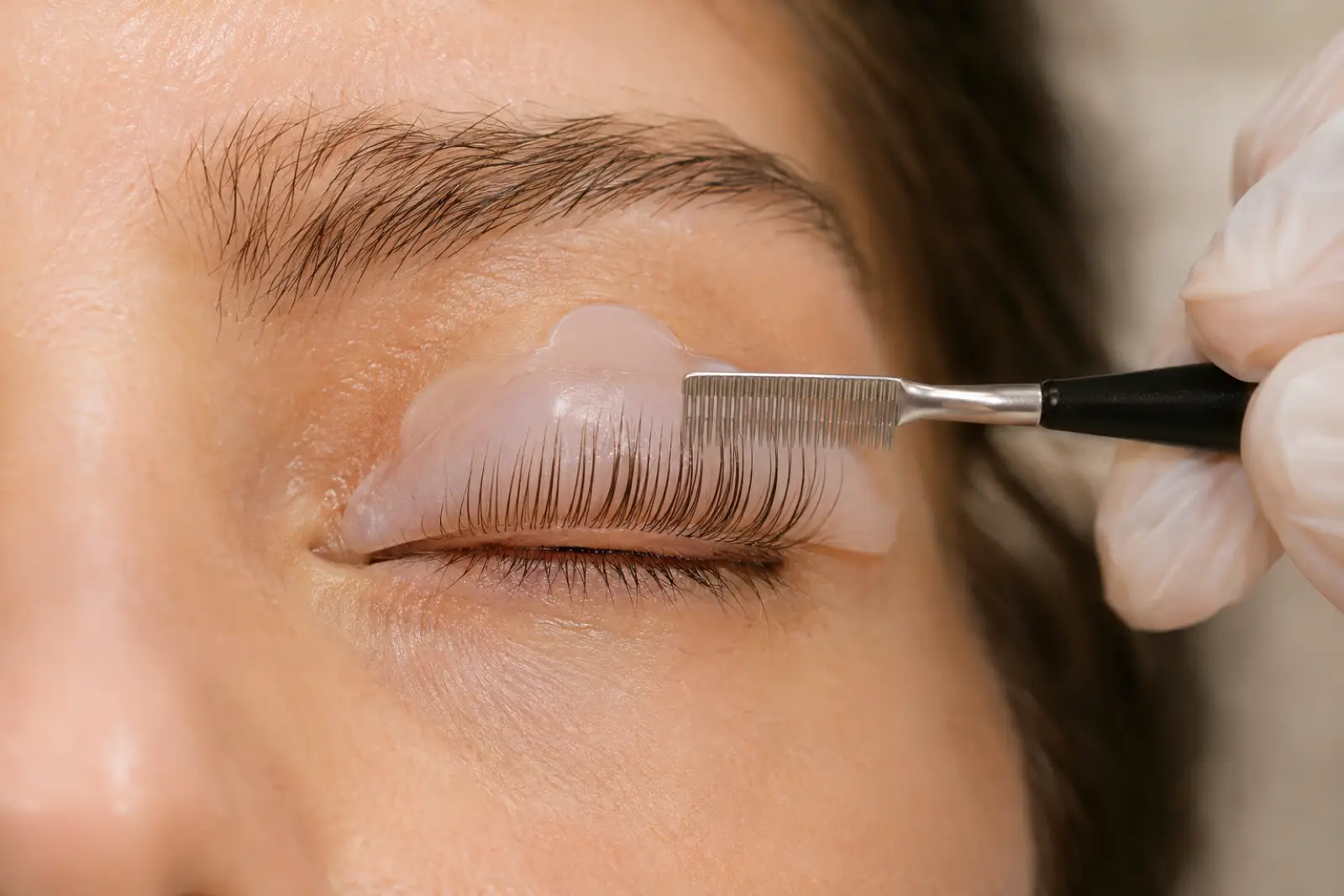
The lash lift is the successor to the old lash perm, and the technique has moved on considerably: instead of rollers, it is worked on silicone shields that carry the lash up over a curve. The result is more open and far less curled than it used to be.
Anyone torn between the two is really deciding two things: how much upkeep they want afterwards, and how much material they want on their face. Both are lower with a lift, and for many people that is exactly why they switch after a year of extensions.
1. How a lash lift is done
The treatment is a perm in miniature and follows the same chemistry as brow lamination, only in a more delicate place.
First the lower lashes are taped down and protected. Then a silicone shield goes onto the upper lid, right against the lash line. Each lash is positioned individually on that shield with adhesive — the most laborious part, and the one that decides how even the result looks. A lash placed crooked stays crooked for six weeks.
Two products then follow in sequence: one that opens the structure of the hair, one that closes it again in the new shape. Processing times run somewhere between five and twelve minutes depending on how coarse your lashes are, and this is where experience shows. Too short means no result, too long means straw-like, frizzy lashes.
A tint almost always follows. It makes sense, because lifted lashes read paler at the tips and colour is what makes the length visible. A conditioning serum finishes the appointment.
Shields come in several strengths. A flat shield gives a soft, wide-open sweep, a strongly curved one a pronounced upward kink. On short lashes the flatter option is usually better: too sharp a kink makes short lashes look shorter still.
A lift works with what you have. Extensions work with what you buy.
2. Who it suits, and who it does not
The people who gain most have straight lashes that grow forwards or downwards. That is exactly where mascara achieves nothing, because the lash covers the eye rather than opening it. A lift reverses that starting point, and the difference is clearly visible in photographs.
It also suits anyone with a low tolerance for upkeep. After a lift there is nothing to do. No infill appointment every three weeks, no ban on oils, no caution while removing make-up. For people who train, swim or work with their hands near their face, that is the practical advantage.
It suits short lashes far less. What is too short to reach over the curve of the shield cannot be shaped — roughly six millimetres is the working threshold. Sparse lashes stay sparse as well, because the lift changes direction, not quantity.
It cannot be combined with extensions. If you wear them, they have to be removed professionally and the lashes given a break before a lift makes sense. The reverse holds too: extensions are not applied to freshly lifted lashes, because adhesive holds poorly on a curved lash.
3. Lift and extensions side by side
The honest comparison is not the single price but the year. Figures are typical US salon ranges for 2026 and vary by region.
| Feature | Lash lift | Extensions |
|---|---|---|
| Effect | lifts and tints | lengthens, adds density |
| Appointment | 45–60 minutes | 90–180 minutes |
| Lasts | 6–8 weeks | 2–3 weeks until an infill |
| Price per visit | 85–140 dollars | 150–300 dollars plus infills |
| Visits per year | 6–8 | 15–20 |
| Annual cost | 550–1,100 dollars | 1,100–2,500 dollars |
| Upkeep | essentially none | daily, oil free |
| Mascara | yes | limited |
What the table does not show: a lift is invisible once it wears off. The lash simply grows out in its original direction, and there is no point at which the result looks patchy. With extensions, the stretch before an infill is visible.
The other way round: if you want length, only extensions deliver it. A lift can make a short lash look longer, but it cannot make it longer.
Related articles
4. The first 24 hours and the weeks after
The shape is not fully set when you leave. For 24 hours that means no water on the lashes, no steam, no sauna, no sweaty exercise, no mascara and ideally not sleeping face down. It is the one rule that genuinely matters — and the most common reason a result looks flatter two days later than it did in the salon.
After that the restrictions largely disappear. Mascara is fine, oil-based cleansers are fine, and swimming or a sauna no longer affects the result. A lash curler should no longer be necessary and would be a poor idea on a shaped lash anyway.
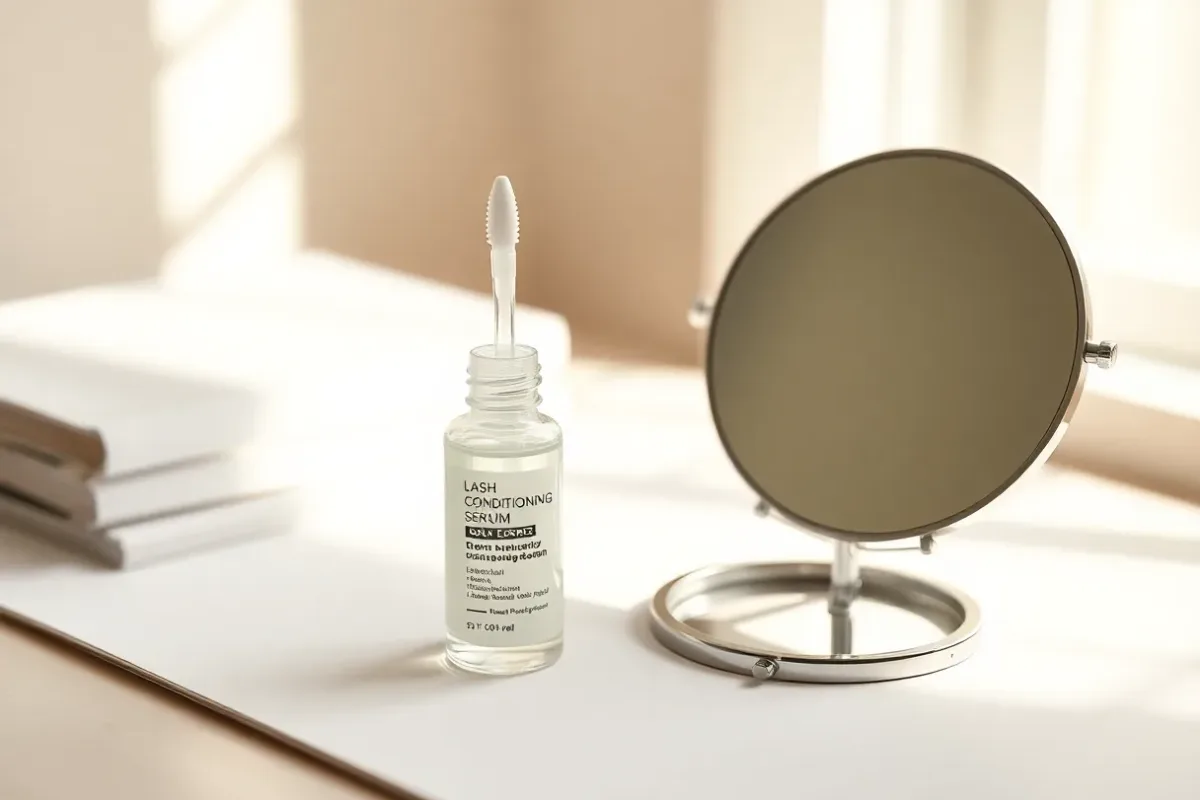
A conditioning serum or a drop of oil on the lashes in the evening is worth the ten seconds. The chemical steps draw moisture out of the hair, and moisture is what keeps a lash flexible.
One thing most people only work out at their second appointment: the lift often looks stronger the next morning than it does when you leave. At the end of the appointment there is still serum sitting on the lashes, weighing them down. If you are underwhelmed in the salon, wait a day before judging it.
Over the weeks the effect flattens gradually rather than vanishing. New lashes grow in unlifted, lifted ones grow out. Six to eight weeks in, a repeat becomes worthwhile. More often than every six weeks is not advisable.
5. Risks, patch testing and contraindications
The products act immediately next to the eye, so the standard for careful work is high. If product reaches the conjunctiva it can irritate or injure. That is rare, and it is the reason a lift is not a job for untrained hands and emphatically not a home kit.
The second risk is over-processing. Leaving the product on too long turns lashes straw-like, frizzy and brittle. They recover as they grow out, but that takes weeks. A salon that times by feel rather than by lash thickness runs that risk repeatedly.
A patch test 24 to 48 hours before a first appointment is standard, especially with a tint. Lash tint is among the more common causes of contact reactions around the eye.
Appointments are usually postponed or declined for:
- conjunctivitis, a stye, blepharitis or any other eye infection
- recent eye surgery, with the timing agreed with your surgeon
- a known allergy to thioglycolate or lash tint
- isotretinoin treatment or a short gap since finishing
- existing extensions, which have to come off first
If you have very dry eyes, recurrent lid margin inflammation, or use a lash serum containing prostaglandin analogues, raise it before booking. Many salons decline during pregnancy and breastfeeding; there is no solid data either way, so the caution is precautionary rather than proof of harm. Contact lenses come out before the appointment.
If your lashes are long enough and it is their direction that bothers you, the lift is the cheaper and far lower-maintenance choice. If you want length or density, extensions are the only route — and the annual upkeep belongs in that decision.
Booking your next treatment without a phone call?
This link is meant for your studio, not for you. If you would rather book online and keep your treatment history in one place, pass it on at your next appointment.