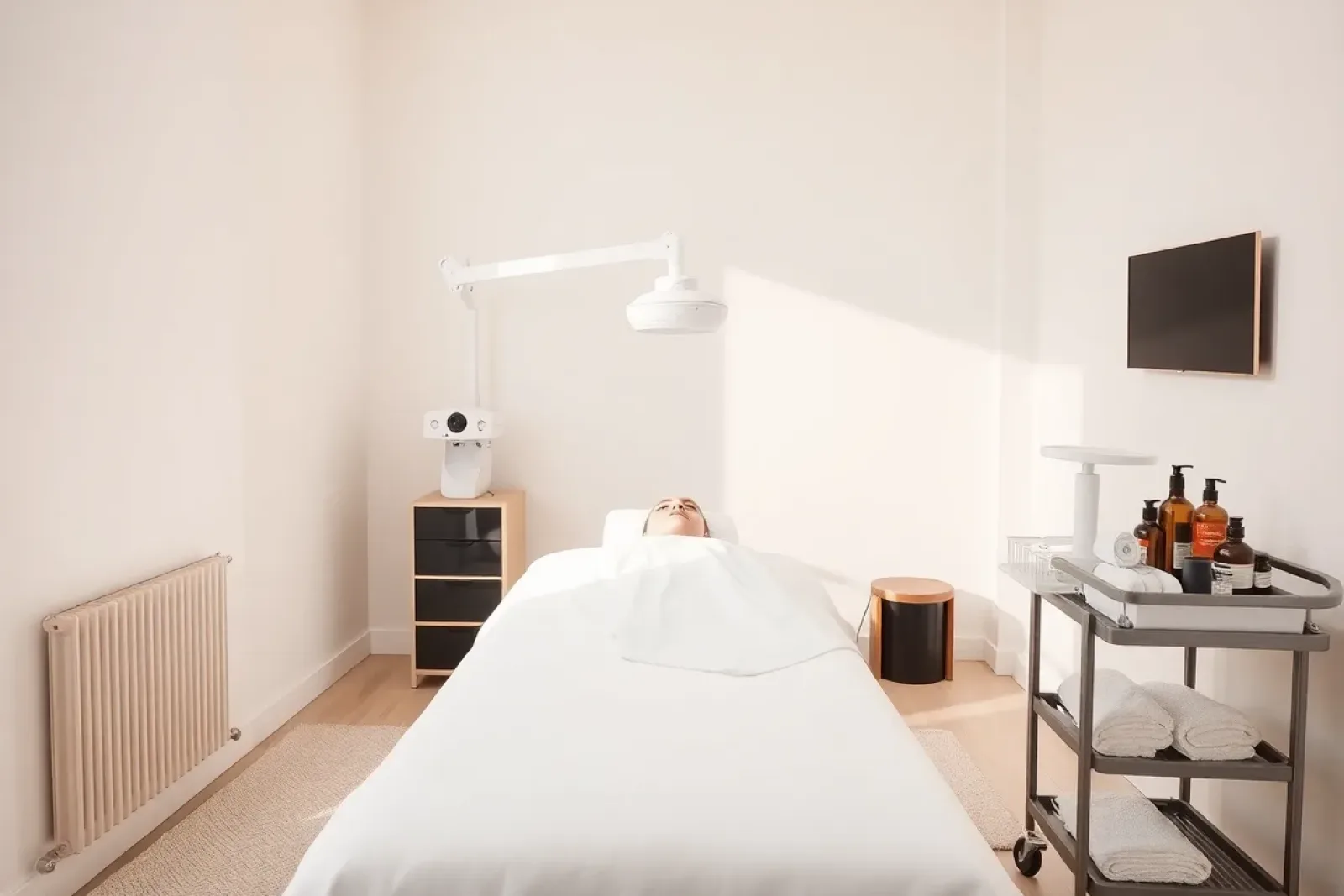
For mild to moderate congestion a salon can achieve a great deal: proper extractions, acid treatments matched to your skin, calming applications and above all a home routine that stops making things worse. Inflamed nodules, cysts or the first signs of scarring belong with a dermatologist.
The most important distinction comes first, not last: congested skin is not the same as acne, and acne has grades. A few blackheads across the nose is a cosmetic matter. Deep, painful nodules that leave marks behind are a medical one. Between those poles sits a wide middle ground where a good salon genuinely helps.
What a salon never does: diagnose, recommend medication or promise a cure. What it does well: take the load off your skin at regular intervals, clear congestion properly, and rebuild your daily routine so that it stops feeding the problem.
1. Where the line between salon and clinic runs
A rough sorting helps more than any treatment list. Where the picture is mostly non-inflamed congestion — blackheads, small closed bumps, enlarged pores — the salon is the right first stop. Once inflamed pustules appear in numbers, both make sense: a medical assessment for the causes and cosmetic support for the surface.
From deep, painful nodules onwards, from cysts onwards, from inflammation that keeps returning to the same spot, and from the moment scars start forming, treatment belongs with a dermatologist. The reason is not caution for its own sake: scars can be prevented but are laborious to correct afterwards, and time is the decisive factor.
Everything that goes below the surface is medical too: prescription actives, hormonal treatment, antibiotics, isotretinoin. A salon may neither recommend nor discourage any of it.
Equally, do not underestimate what a salon adds. Someone who is extracted properly at regular intervals has far less reason to pick at their own face — and self-manipulation is among the most common causes of scarring that need never have happened. Salon and clinic are not competing here; they work on different layers of the same problem.
Most flare-ups do not come from too little treatment. They come from too much skincare.
2. What actually happens in the treatment room
The core is nearly always softening, extracting and calming. Softening happens with steam, a compress or an enzyme product so the plug in the pore loosens. Then come the extractions: with fingers over tissue, with a comedone loop or with an ultrasonic spatula. Inflamed pustules are left out of it. Anything red and swollen gets cooled and calmed, not squeezed.
Depending on the skin, add:
- salicylic acid, because it is oil soluble and reaches inside the pore
- acid or enzyme peels to loosen the build-up that blocks pores in the first place
- anti-inflammatory applications with zinc, niacinamide or calming botanicals
- blue LED light, aimed at the bacteria in the pore and used alongside the rest
- microcurrent or ultrasound to drive actives in
One thing matters as much as any of it and rarely appears on the price list: a review of what you are already using. The cause frequently turns up there — a stripping cleanser that dries the skin and drives oil production, a rich cream sealing the pores, daily scrubbing on inflamed skin. A salon that removes two products from your routine instead of selling you five has understood the assignment.

3. Series, cost and what you can realistically expect
A single treatment relieves but changes little. Because the epidermis renews itself over roughly four to six weeks depending on age, repetition is the actual mechanism.
| Picture | Sensible approach | Rhythm | Cost per visit |
|---|---|---|---|
| Blackheads, little inflammation | extractions, salicylic acid | every 4–6 weeks | 110–180 dollars |
| Congested combination skin | series of peels and extractions | 4–6 visits, 2–4 weeks apart | 110–200 dollars |
| Many inflamed pustules | medical assessment, salon alongside | as agreed | 100–170 dollars |
| Nodules, cysts | dermatology | medically determined | medical care, not salon pricing |
It is also worth stretching the interval once the skin settles rather than holding it. After a series, most people keep the result with a visit every six to eight weeks. A salon that keeps the same frequency indefinitely is selling repetition rather than progress.
Realistic after a series: fewer blackheads, calmer skin, a more even picture and noticeably less new congestion. Not realistic: permanently clear skin, the disappearance of existing scars, or smaller pores.
An initial worsening is possible and not a bad sign. After the first treatments what was sitting below comes up. It often takes two to three weeks, which is why a series should not start shortly before an occasion that matters.
Related articles
4. What happens at home matters more than the appointment
Ten minutes a day outweighs sixty minutes every four weeks. The routine that carries most people is unspectacularly short: a gentle cleanser morning and evening, one active, a light moisturiser and sun protection during the day.
The common mistakes are well documented. Over-cleansing dries the skin, and dry skin makes more oil. Scrubbing inflamed skin spreads bacteria and adds irritation. Too many actives at once — acid, retinoid and benzoyl peroxide side by side — disturb the barrier to the point where skin reacts to everything. And alcohol-heavy toners buy a brief feeling of cleanliness at a high price.
What works is patience with one variable at a time. Introduce a new active over two to four weeks, starting every second or third evening. Judge it after six to eight weeks, not after one. And keep sun protection in the routine, because many actives increase photosensitivity and because sun sets the dark marks left by healed spots.
On squeezing at home, one plain rule holds: if it does not release under gentle pressure, it is not ready. Anything beyond that pushes the contents deeper, prolongs the inflammation and raises the risk of a scar considerably.

5. Marks left behind, and what comes after
A healed spot frequently leaves a mark. Two kinds exist and they behave completely differently. Red marks are dilated vessels and usually fade on their own over weeks to months. Brown marks are pigment the skin produced in response to the inflammation; they last considerably longer and are reinforced by sun.
Neither is a scar. A scar is a permanent change in the tissue — indented, raised or thickened. The distinction matters, because marks respond well to cosmetic support while scars need different methods entirely.
Against pigment marks a salon offers mild acid series and active-led treatments; at home, sun protection and patience count for more than any product. Trying to fade a mark while going out in the sun unprotected is working against yourself.
And where real scarring has formed, that treatment begins only once the acne is settled. Before then, any scar work is an appointment that the next breakout overtakes.
One last note on diet. There are indications of links between diet and acne, but they are neither the same for everybody nor clear enough to support a general recommendation. If you want to experiment, do it with medical guidance rather than on advice offered in passing during a facial.
Work out which band you are in first, then pick the address that matches. If you are unsure, the dermatology appointment is the first one and the cosmetic series the second — not the other way round.
Booking your next treatment without a phone call?
This link is meant for your studio, not for you. If you would rather book online and keep your treatment history in one place, pass it on at your next appointment.