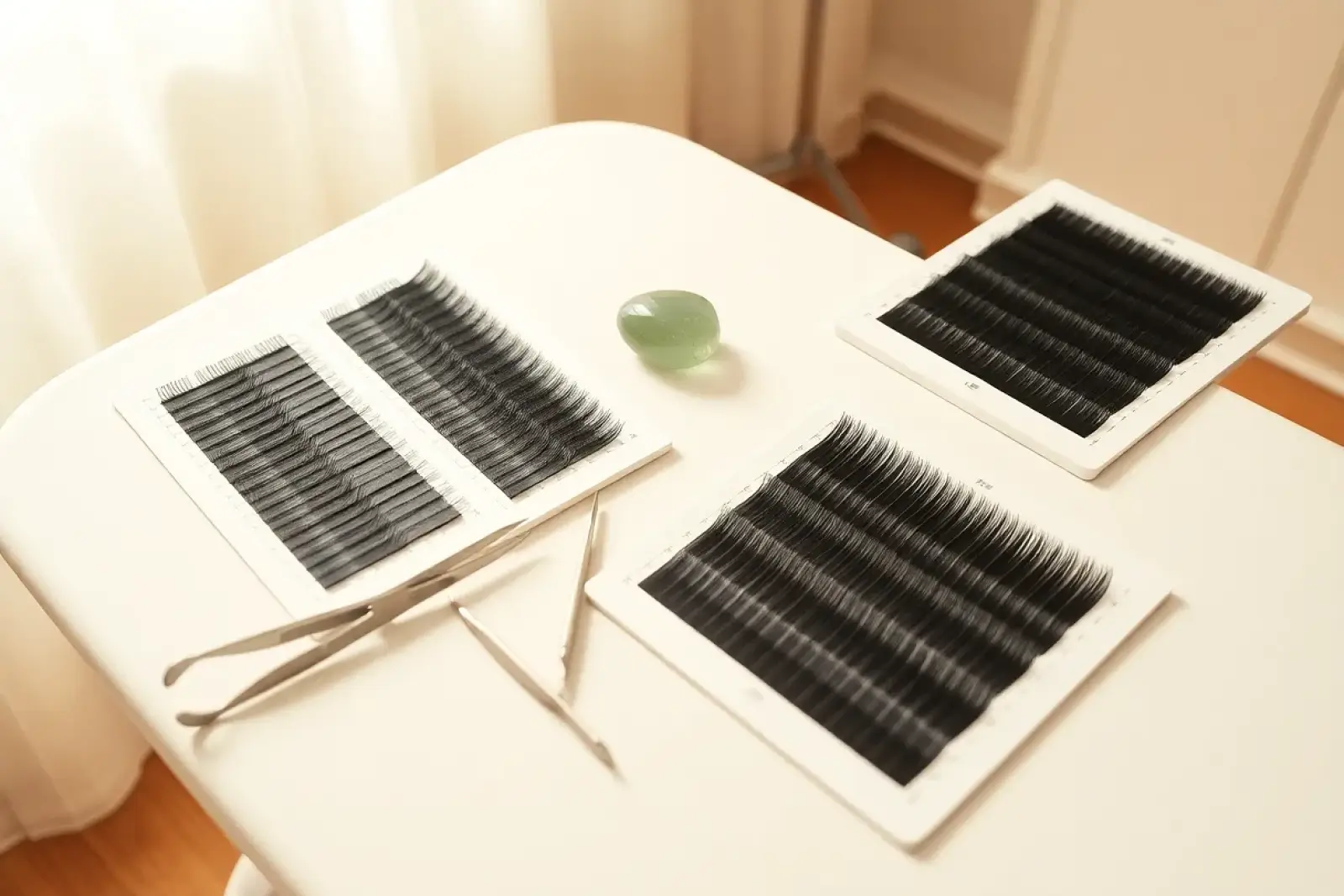
The first appointment is not the bill. Lash extensions are a running cost: infills come round every two to three weeks, and an infill usually sits at about half the price of a full set. Volume costs a good third more than classic because the appointment runs longer — what you pay for is time in the chair, not material. Leave it too long and you are buying a full set again.
Price lists do not answer the question you are actually asking. What they show is a starting price for the plainest set: shortest length, lightest density, natural lashes that cooperate. What you end up spending hangs on three numbers that rarely appear side by side — the price of a full set, the price of an infill, and the day on which an infill starts being charged as a full set again.
That third number is the most important one and almost nobody asks for it. It decides whether you have six appointments a year or twenty-five, and therefore most of what lashes cost you. Know it and you can do the maths. Know only the starting price and you will be surprised every time.
1. You are paying for time in the chair, not for material
The material in a set of lash extensions is cheap: one strip of extensions, a few drops of adhesive, pads and tape. What is expensive sits next to it — two to three hours of one person's undivided attention, in a rented room, under a good lamp. So the price is essentially appointment length multiplied by the salon's hourly rate, plus a modest share for products and hygiene.
That explains nearly every gap on the price list. Volume does not cost more because the fibres are dearer; they are finer and, per hair, actually cheaper. Volume costs more because the technician builds every fan by hand before placing it. Depending on the density that is thirty to sixty minutes on top, and those minutes are what the surcharge is.
The same arithmetic explains why the identical technique costs different amounts in two salons on the same street: rent, experience, and above all the length of the appointment booked. A salon that blocks two hours for a classic set cannot charge what one that blocks a single hour charges — unless less happens in that hour.
| Technique | Appointment length | Price relative to classic 1:1 | Where the difference comes from |
|---|---|---|---|
| Classic 1:1 | 90–120 min | the salon's reference price | one extension per natural lash |
| Hybrid | 120–150 min | around a fifth above it | part of the lash line is set as fans |
| Volume 2D–4D | 120–180 min | a good third to a half above it | every fan is shaped by hand, one at a time |
| Mega volume 5D+ | 150–210 min | roughly one and a half to two times | more hairs per fan, finer handwork |
So read a price list like a clock. If two offers cost the same but one books ninety minutes and the other a hundred and fifty, those are not two prices for the same thing.
The price of the first appointment tells you very little. The price per month tells you everything.
2. A full set and an infill are two different bills
A full set builds the whole lash line from scratch. At an infill, grown-out and twisted extensions are taken off and the natural lashes that have come free are re-lashed. It takes roughly half as long as a full set — allow 45 to 75 minutes — and most salons price it accordingly, at about half. That is the number you live with, not the one from your first appointment.
Why every two to three weeks? Because your lashes run on a cycle. Each one grows, rests and sheds, and the extension goes with it. After two weeks a quarter is often missing, after three weeks roughly half. While the majority is still in place, an infill is quick and worth doing. Below that, the arithmetic flips.
Whether your appointment is billed as an infill or as a full set comes down to three things:
- how many extensions are still sitting — below about half it is no longer an infill but a rebuild
- how the remaining ones sit — twisted, turned and grown-out extensions have to come off anyway, and that takes time
- when you were last in — many salons simply tie the infill rate to a fixed window
The tiering usually looks like this: the cheapest rate up to day 14, the normal infill rate up to day 21, the full set price after that. It is not a trick, it is an honest picture of the work — after four weeks the technician removes more than she places. Ask about that window before your first appointment. It is the number that sets your yearly cost.

3. The bill over a year — and why waiting costs more
It gets clearest when you count in full sets rather than in money: one full set is a unit, one infill is half a unit. This works in any salon and any currency, and it stays true when the price list changes.
| Rhythm | Appointments a year | Yearly cost, counted in full sets | What it means |
|---|---|---|---|
| Every two weeks | 1 full set + 25 infills | about 13 to 14 full sets | permanently full lashes, the most expensive option |
| Every three weeks | 1 full set + 17 infills | about 9 to 10 full sets | the usual rhythm, the last week looks gappy |
| Every four to five weeks | 10 to 13 appointments, nearly all as full sets | about 10 to 13 full sets | feels thrifty and costs more than every three weeks |
| Twice a year for a few weeks | 2 full sets + 6 infills | about 5 full sets | for occasions, with a real break in between |
The third row is the one worth reading twice. Skipping an infill feels like saving money and is the most expensive rhythm in the table: once too little is left, the technician starts over, and because the time is the same as a full set, so is the price. If money is tight, the answer is not to come later but to pick a lighter technique and keep the rhythm.
If you need an order of magnitude in money: in the United States a classic full set in 2026 typically runs somewhere around 120 to 200 dollars, with an infill around 60 to 95 dollars. New York, Los Angeles and San Francisco sit well above the top end, smaller towns below the bottom. Treat those figures as something to ask about, not as a price list — the ratios in the tables above will outlast any number.
Related articles
4. What else lands on the bill besides the appointment
A handful of items rarely appear on the price list and reliably appear on the bill. None of them is dramatic on its own; together they are the difference between the price you budgeted for and the one you pay:
- Removal: done properly with a remover, 15 to 30 minutes. It usually costs a fifth to a third of a full set, and is often waived if a new set goes on in the same appointment.
- Infilling somebody else's set: many salons add a surcharge or remove everything first, because they will not stand behind another technician's work. Ask before you switch salons.
- Patch test: reputable salons offer one, usually free — but it is a separate short appointment a few days ahead.
- Aftercare at home: an oil-free cleanser and a spoolie, bought once and small in proportion. Skip them and the set lasts less time, which you then pay for at the appointment.
- Late cancellation fees: lash appointments are long and hard to refill at short notice. Same-day cancellations are frequently charged.
- Extras: coloured lashes, unusual lengths, bottom lashes. Rarely listed, and added per appointment.
It pays to ask about all of these in one go at your first appointment rather than discovering them one at a time. A salon with clear answers here also has clear costings.
One item is deliberately missing from that list: correcting a badly placed set. If a set has to come off early, you pay twice — for the removal and for a new set. That is the most expensive way to save money on a first appointment, and it is the reason for the next section.

5. How to recognise a price that is too cheap
There is one calculation that works in any city and any currency: divide the price by the length of the appointment booked. A full set is two to three hours in which one person does nothing but work on you. If the hourly figure lands clearly below what an hour of skilled handwork costs in your town — a haircut, a manicure, a massage — then somebody is subsidising it, and it is not the salon.
The savings show up in predictable places: in the number of extensions actually placed (a "full set" in 45 minutes is not one), in thicker, cheaper single lashes instead of fine fibres, in fast-curing budget adhesive, in isolation — stuck-together lashes pull several natural ones out when they shed — in the patch test, and in the time to look at your natural lashes at all.
These questions cost nothing and answer almost everything:
- How long is the appointment booked for? Under 90 minutes, a full set is not a full set.
- Is every natural lash isolated individually, and roughly how many extensions go on?
- Up to which day does the infill rate apply, and what does the appointment cost after that?
- What does removal cost, and is it included if a new set goes straight on?
- Is a patch test offered, and how many days in advance does it need to happen?
- Who will be working on me, and how long have they been doing this?
There is, incidentally, an honestly cheap appointment: modelling for a trainee, under supervision, openly advertised as such. That is a fair trade — you pay less and bring time and patience. The suspicious version is the other one: the full price of a full set, in a third of the time, with not a word about who is doing the work.
Three numbers decide what lashes cost you over a year: the price of a full set, the price of an infill, and the day on which an infill turns back into a full set. The third one appears on no price list and matters most of all.
Ask for all three before your first appointment and scale them to your own rhythm. Then you know in advance what you are signing up for — which is more than the starting price will ever tell you.
Booking your next treatment without a phone call?
This link is meant for your studio, not for you. If you would rather book online and keep your treatment history in one place, pass it on at your next appointment.